How to visit the Far East without leaving Britain
Yes you may have guessed at this somewhat jokey allusion –
the East of England, or at least Suffolk.
Willy Lott's Cottage, Flatford
Saturday 29th June.
After a somehat frustrating day at Wimbledon in which
Lindsay manages to lose her phone, and we have to leave before the end of the
Federer vs Bennetau match because of a timed rail ticket, we start early and
fix our new BMW bike rack to the tow ball of the X3. The rack is the most impressive piece of
German engineering and is rock solid. It
comes complete with its own lights and light connection. Of course it costs a fortune, but will be perfect
for ever so long as we own a BMW with a tow hitch. Off to Essex.
Reasonable journey despite the heavy traffic and arrive in Langham, at
the house of Paul Armstrong, whose company, Coolpedals, is coordinating our
trip. Paul, or Mr Cool as we have named
him is a fairly typical keen biker. His
website says ‘plenty of off-road parking’ so we miss the bungalow first time
around as we drive along his road. More
a bungalow industry than a cottage industry then. Equipped with maps and with a GPS affixed to
the stem we are off up the Box valley and down the Brett valley – a rather roundabout
18 mile route for getting to Dedham, which is our first night’s stopping point. Dedham is in fact only 3 or 4 miles as the
crow flies from Langham. A breezy
afternoon of open skies and fields, breezy, and sunshine, tiny streams and
short steep descents and climbs. An
unconcerned partridge looks at us from the opening of a wheat field. We miss Milsom’s Hotel as we cycle past and
detour into Dedham for a quick first look at Constable country. JC was born nearby in East Bergholt, and many
of his landscapes include Dedham Vale, or the church, the building of which was
started in the year Columbus discovered America. One of Constable’s only 3 religious
paintings, an Ascension, is in the church.
It’s a somewhat unimpressive imitation of many Renaissance pieces, and
we are sadly underwhelmed by it. Apparently
the purchaser defaulted on payment and Constable is not thought to have worked
too hard on the lower half. Good job he
stuck to landscapes. In fact he was only
modestly successful during life, despite his admittance to the Royal
Academy. For example he sold more
paintings in France than he did in England.
Curiously, during the week we are in Suffolk and Essex one of his
paintings, ‘The Lock’, sells for about £28 million. Xerxes would rather like to visit his grave,
but unfortunately that turns out to be in St John-at-Hampstead in London. Of more interest in the church are the
tablets recording the passing of its residents or their relatives, in the great
era of colonial expansion. One
inscription which catches my eye is a plaque dedicated by a widow to her late
husband, the final line of which states something like ‘… this stone was caused
to be placed by his affectionate relict.’
‘Would you be my affectionate relict?’ I ask Lindsay.
It’s a lovely warm afternoon with big skies over Dedham Vale
and typical Constable fluffy white clouds in the skyscape, so we are not sorry
that we cycled past Milsom’s. We’ve
booked in at Le Talbooth for dinner, and this is excellent, Michelin star
standard cooking, with a wine list to match, although, understandably, not
cheap. In fact it’s the most expensive
meal of the holiday, but the value of the pub and hotel food that we find after
this is pretty good. After an initial
celebratory glass of Moet we select a Thelema 2007 Cabernet Sauvignon, which is
gloriously smooth and rich. The choices
we make include pigeon, rabbit, scallops, ham hock terrine, lamb, venison,
fillet of beef. On return, Murray vs
Bagdatis is still in progress at Wimbledon and sets a record for finishing at
two minutes past eleven. The first day
of Le Tour (de France, not Suffolk) features Cancellara as the winner of the
time trial.
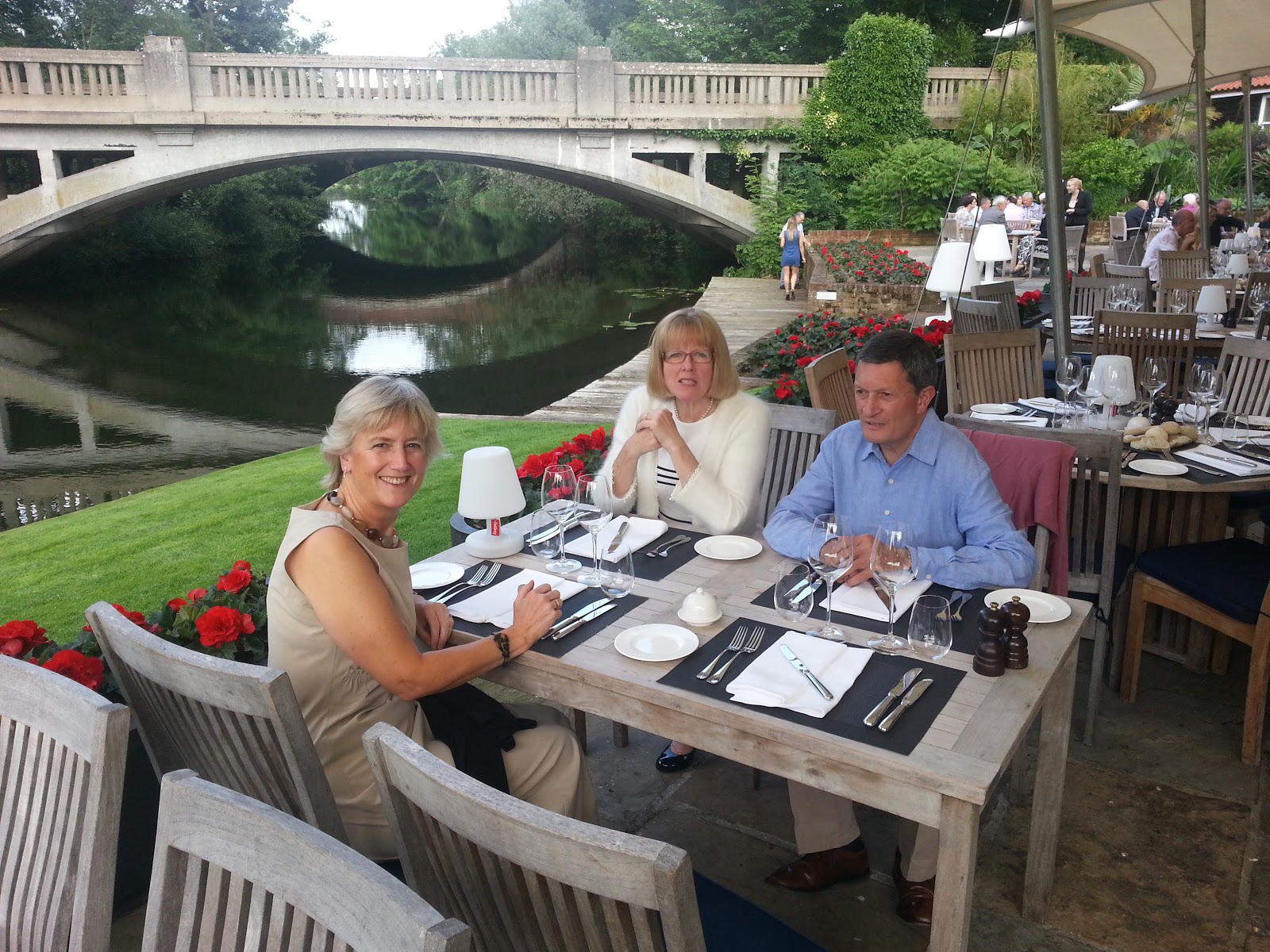
At Le Talbooth, the bridge marks the old boundary between
Essex and Suffolk, crossing the river Stour.
Around us on the terrace (it’s a lovely warm evening though space
heaters are also needed as night draws on), Essex man is in his element,
distinguished by open neck shirt and tan, and Essex woman is also on display,
distinguished by short skirts and teetering high heels. Mercurey Premier Cru is going down well at
the table next door.
Le Talbooth
Sunday July 1st.
A long ride ahead so
breakfast at 8 and on the road at 9.
Back into Dedham and then a roundabout route to East Bergholt with its
beautiful old church and unusual bell cage.
Then down to Flatford Mill, Willy Lott’s cottage, etc, the scenes of
Constable’s most famous paintings.
Unfortunately one wouldn’t really recognize the ford and there is no
haywain. There is a long diatribe in the
visitor’s book about the building of the tea rooms which apparently prevents
one from observing the ford and bridge as Constable might have seen it. The atmosphere is peaceful and it is sunny
and warm. Roses on the red brick walls, more
fluffy white clouds, a swan on the pond.
It’s the front of a chocolate box or perhaps possibly a jigsaw. In fact, throughout the trip there are many
scenes that remind me of my childhood jigsaws –‘Now does that yellow rose go
there by the wall or is it part of the one by the gate? Shall I start on the thatched roof, or are
there too many pieces to get into it first?’


Chocolate box scenes
East, along the Stour, towards Shotley. Detour around the massive Royal Hospital
School, then past the church at Erwarton, where legend has it that Anne
Boleyn’s heart was secretly buried, and indeed a heart shaped casket was found
there in 1838, set into an alcove in the church… Erwarton Hall next door is a magnificent 16th
century manor house. We stop in the pub
before Shotley and enjoy excellent pasties, before cycling on a rather bad
(footpath) route to Shotley itself and its marina. I’m told that we must have cycled past Griff
Rhys-Jones’ cottage, but we didn’t see him…
Erwarton Hall
It’s a very windy grey day and it’s easy to spot the rather
peculiar shallow draft ferry that is buffeting its way towards the dock. It’s a truism that all professional mariners
grumble, and the crew of the Harwich, Shotley & Felixstowe ferry are no
exception. There is a sign in the
wheelhouse which says ‘We hate tandems’, and this is not surprising because the
arrangement for bicycles is a sloping bow section which has wheel racks for six
bikes. Then they are lashed down, and
with us and a few tourists plus dogs we set off. The crew of two are accompanied by a third
who turns out to be the engineer. The
very substantial diesel engine is purring beautifully under the floor. To try to cheer up the morose skipper I remark
on this. ‘Bloody miracle it goes at all’
he says. ‘The man who services it is
standing next to you and he retires next week’, he adds gloomily, looking
reproachfully at his colleague. The other
passengers have two dogs. The Alsatian
doesn’t look too keen to come aboard and stands uncertainly looking as though
it is going to be sick at any moment.
The dim owner decides this is the time to try it with a grape, but
neither the Alsatian nor the lapdog is keen.
At least they have more sense than their owners. Fortunately they alight at Harwich quay. Xerxes has assured me that Harwich is a
lifeboat repair centre, but since there is only one lifeboat visible and there
are a surprising number of lightships everywhere he recalls suddenly that it is
for lightship refits that Harwich is famed.
We set off again for the Felixstowe shore. This time it’s straight into the chop and
salt water comes over the bow and onto the bikes. At last we discover that the landing craft
morphology of the ship’s bow is there for a reason. The helmsman just drives the boat into the
beach. They slide a gangplank from the
bow of the vessel and we gingerly wheel everything ashore. This method obviously can only work because
the beach shelves steeply, and the stern and the prop remain in deep water. We still have one more ferry crossing to
make, the so-called Felixstowe ferry, though it is somewhat north of Felixstowe
and crosses the River Deben. On the
Shotley crossing the crew warn us that the skipper of this boat is ‘short,
sharp, and miserable’. The contrary
proves to be the case, unsurprisingly because John the ferryman proves to be
quite genial, and he charges about twenty times as much as the Shotley ferry’s
charge when calculated as distance run. ‘Oive got an ‘ernia’, he says as he watches
us struggle with lifting the bikes over the rail of his boat. He is as brown as a berry, with a piratical
ring in one ear and curly grey hair. In
costume one could imagine him as a seadog of Nelson’s time, though in merely
taking passengers across the river mouth he has a somewhat easier time of
it. Prior to the Deben we pedal along
the seafront at Felixstowe which reminds me of Bournemouth, but Lindsay finds
it enchanting, and I suppose that it is somewhat more genteel than
Bournemouth. Large tankers and container
ships pass offshore, and there are glimpses of the treacherous sandbanks which
lie far out to sea.

The beach at Felixstowe
The piratical John, and his crew. River Deben, Suffolk
The route to the Felixstowe ferry takes us through the golf
course to the north of Felixstowe, and having made the two minute crossing of
the river mouth, and handed over the sum of £14 to the cheery John (perhaps our
former shipmates were jealous of his comparative earning capacity), our route
lies along the north side of the estuary heading inland in a Westerly or Northwesterly
direction. Our route from Mr Cool
detours us to Ramsholt, a pretty sailing village on the side of the Deben,
where we get lost trying to follow his off road directions, but eventually
return inland to the ‘B’ road, and give further diversions a miss, because it is
getting late. Regretfully we give Sutton
Hoo a miss, and having crossed the river from Northeast to Southwest bank we
strike a bridleway inland and emerge in the little village of Melton, which is
more or less conjoined with Woodbridge.
Leaning on the wall of St Andrew’s church, sitting on my bike saddle I
can see a vicarage tea party taking place.
The vicar, in that type of soft hat, and down-at-heel jacket over a black
clerical shirt that only vicars seem to manage to acquire and carry off
successfully, sees me waiting for the others and calls us in for tea. A wonderful opportunity to use the Tony
Hancock line, ‘More tea, Vicar?’ and we don’t need much compulsion after 50
miles in the saddle. The price for his
strawberry cream tea is a modest £5 a head, with unlimited tea, a piece of fine
cake, sandwiches, and a scone with jam, cream, and strawberries. How they will ever make enough for whatever
it is they are saving for I don’t know.
This providential experience is just what we need. The vicar warmly invites us to stay on for
the multi-denominational service which is to take place later, but he is a bit
nonplussed when Philippa plays a masterstroke and announces that Xerxes is a
Zoroastrian, being Parsee, and admits that he is not sure that this has been
included.
At any rate, it is now getting quite late and we still have
a couple of miles to pedal into Woodbridge where after a short delay, we find
the B&B, St Anne’s Schoolhouse, located in a secluded road just behind the
main street, and only yards from The Crown where we have booked for
dinner. After dinner, which is good, the
others forage around the boutiques of Woodbridge, but I return to catch the end
of Euro 2012 (Spain 4, Italy 0). Paper,
diary and bed. Over 50 miles and 2600
feet of ascent and descent.
The Deben
Monday 2nd July.
Very tired last night and slept well, despite rain
occasionally drumming on the Velux windows.
Today is not such a long itinerary, about 36 miles. We cycle north then east, sandy and gravelly
woodland trails, separated by some open land with piggeries, and subsequent
fields immaculately planted with pink flowering potatoes, to the pretty village
of Orford, low-lying, grey, and gusty, with its boats rocked by a howling wind. There is a welcoming café, for drinks and a
cake. It has a castle and a famous
oyster shop called Pinney’s. Leaving
here, it’s an enjoyable ride along small lanes on the ‘Suffolk coastal cycleway’
up to the top of the Alde estuary at Snape, the famous Maltings and concert
hall. It is sunny and warm when we get
here, though breezy still, and we wander the grounds admiring the sculpture (if
that is the right description) by Henry Moore, Alison Wilding, and Barbara
Hepworth. In the distance, I can see a
few families admiring a Suffolk punch horse and cart, no doubt waiting their
turn for a ride. We do not visit because
we are anxious for lunch, but I discover now I am writing this that it is
actually a painted bronze statue by Sarah Lucas! The fish soup in the Plough and Sail pub is
excellent. Then it is back towards
Woodbridge and Lesley’s excellent B&B, but first we have to negotiate some
more forest tracks which are becoming muddier.
Eventually deciding that tractor ruts and deep grass were not for us we
detour via Wickham Market to come down into Melton via Ufford. A good dinner at the very traditional ‘Ye
Olde Bell and Steelyard’ pub.
Tuesday July 3rd.
We leave Woodbridge sharp at 9am. The rain has drummed on the Velux windows
during the night but it is only grey above us as we cycle down to the Deben, and
then turn up Martlesham Creek, with remote and beautiful mud flats, the cries
of burbling curlews in the air. Across
the dam and sluice at the top; it is not so funny of Mr Cool to give us a route
up through the woods which involves carrying the bikes up steps. Meandering through small roads we eventually
track onto the main ‘A’ road which crosses the Orwell South of Ipswich. Finding the bicycle route is tricky and the
track beside the main road is covered with debris. The screaming of cars and lorries beside us
on the other side of the crash barrier is unnerving, but we lift our bikes over
the bank at the end of the bridge and join a small road towards
Woolverstone. Pedalling past the
magnificent Woolverstone Hall, aka Ipswich High School for Girls, we take some
small roads and tracks, crossing fields of pink flowered ‘Maris Pier’ potatoes,
down into the picturesque village of Pin Mill, scene of two of Arthur Ransome’s
books for children in the ‘Swallows and Amazons’ series. It is the ‘Butt and Oyster’ which claims our
attention, and Lindsay, first inside, finds us a lovely table in the window
where we can gaze out at the yachts and the few remaining Thames barges which
still ply the river. The beer is
welcoming and fed by gravity feed, and the food is good. Xerxes’ sea bass in paper looks
excellent. The fish stew and Philippa’s
roll mops are good too. Regretfully
leaving PinMill, it is quite a steep haul up to the top of the peninsula where
we cross to the other side and back to the Stour. Around Alton Water again, this time on the
east side, we move inland and gradually make our way to a disused railway track
which takes us into Hadleigh.
Unfortunately it is another five miles in drizzly rain, our first real
encounter with it, to Stoke by Nayland, arriving at The Crown, where we have
lovely rooms and the misery is forgotten in the bath and the warmth of the
white fluffy robes. A good dinner – but
I don’t remember it. We have done 52
miles and experienced three punctures, the last one of which was in my back
tyre a mere half a mile from the Inn.
Wednesday July 4th.
The breakfast at the Crown is a gourmet one, which has to be
ordered, so delays us a little, though pleasurably. French toast, eggs royale, etcetera. We leave to the West, going downhill past the
church on a tiny track. A circuitous
route around Stoke by Nayland golf club and a longer detour because of a closed
road, and then I have yet another puncture.
On a stone concrete hard standing outside somebody’s house, it turns out
that the owner is indoors, and far from being offended he offers us coffee and
biscuits. Moving on through small roads
our final route into Lavenham is along the inaptly named Clay Lane, which is
neither of clay, nor yet a lane. It is a
muddy track, our wheels becoming caked with mud, and we have to stop several
times to clear Lindsay’s mudguards with a stick. Careering along, rather too audaciously,
eventually my wheels slip suddenly sideways and I am off my bike, through the
nettles and into the ditch. A few
scratches and grazes, but fortunately no damage. There has been sufficient nocturnal rain for
us now to decide to avoid Mr Cool’s tracks altogether, and to find substitute
routes, preferably on small roads, which avoid them. In addition the extensive rains in June have
increased the grass and nettle cover alarmingly. Arriving in beautiful Lavenham we are able to
sit in the sun opposite the Guildhall and outside the Angel Inn. An excellent loo allows me to clean the mud
and blood off, and some beer and a light lunch from the Marco Pierre White menu
makes us feel better. We visit St Peter
and Paul church, Lavenham’s famous landmark (late perpendicular; built 1485 –
1525) and pedal on to Long Melford. Then
West to Liston through idyllic pastoral countryside, full of meadows, brown
cows, ponds, rushes and swans. The edges
of the roads are decked with wild flowers and purple mallow. On small roads, we eventually reach the
George at Cavendish. Our only
disappointment of the trip is that Lindsay and I have a disappointingly small
room instead of the one that we have paid for.
However; off to Water Street, where Xerxes’ cousin lives. Firoza, and her husband Geoff, provide us
with Crémant
de Bourgogne and then we retrace our steps to the George, where the landlord,
obviously feeling guilty, provides us with a bottle of house wine – a not too
generous recompense. After this though
we order a decent bottle of Chianti Classico, so the house wine becomes a
distant memory. Good scallops and
langouste, steak, chocolate mousse, and bed.
A route of about 38 to 40 miles to get here.

The Guildhall, Lavenham
Thursday 5th July.
This is rather a noisy location. The traffic starts going by just after 5 am,
so the window has to be closed. The
breakfast is good. We start by retracing
our steps, or route, before heading North in a big anti-clockwise loop. Unfortunately two more punctures in
Philippa’s front wheel and another slow puncture in my rear wheel lead us to
feel that we need a bike shop and some new tyres. A low point is reached as we pass through
Steeple Bumpstead towards Hellions Bumpstead where Xerxes remembers attending a
wedding, and there is a pub. Sadly the
pub is closed, as are quite a few of the old country pubs. On into another village which fortunately has
a shop. Drinks and ice cream are all
that is available, but they are welcome.
As we travel on Xerxes remembers that the wedding wasn’t here after
all. Surprisingly I feel no sense of
enmity towards him, realising that all of our memories of our youth are
pleasant, but fickle. The pub’s loss was
also the village shop’s gain. Passing on
into Saffron Walden, a town with a pretty centre is distinguished for us by
finding a wonderful bike shop in Hill Street, Newdales, with a real expert in
charge, and yards away, the popular tea shop, Cou Cou’s. A remarkably short time later, and Philippa
and I now having puncture resistant tyres, we confidently travel on past Audley
End House, then South, then West, and finally South again to the Cricketer’s
Inn at Clavering, a distance of about 38 miles.
The Cricketer’s is well organized and we are in a separate
building with smallish but very adequate rooms.
The keys come attached to a beautiful new looking genuine 5½
ounce cricket ball, so it is unlikely that one will decamp with them. The food is good and the pub is busy. It’s a lovely evening. People are sitting outside and there is a
beautiful open top Ferrari sitting next to an equally immaculate Morgan. Inside, more Essex man, a somewhat pluffy (as
my mother would have said) young man in jeans and white T shire with a very
shapely blonde in full Essex war paint, and pencil slim white sheath skirt and
leopard print top, the obligatory heels visible underneath the table. They order ‘blush’ wine… Unfortunately we don’t get to meet Jamie
Oliver’s parents, for it is they who own and run the Cricketers. (A note for our transatlantic friends – Jamie
Oliver is a TV chef, big on personality and Essex/Cockney style
familiarity. He has, unlike others,
tried to tackle issues as diverse as restaurant unemployment and school
dinners.)
Friday 6th July.
At last we get to meet Trevor Oliver, Jamie’s dad, for it is
busy at breakfast and he is obviously drafted in to help where he works busily
waiting tables. He’s an easy-going, friendly
man, and sounds just like his son. His
breakfast sausages are fantastic – almost pure meat – so we engage him in
conversation about them. He’s proud to
tell us that they make them on the premises, ever since his butcher
retired. Trevor manages to insert the
interrogative ‘Yer know what I mean’ in a terrific Essex accent at least five
times in the space of two minutes. Jamie’s
TV training has obviously cured him of this habit. Another table is occupied by an entirely
Asian group of young men, about 12 in all, and one woman, who are recovering
from attending a wedding. Despite the
now steady drizzling rain outside most of them are wearing dark glasses, and
either still intoxicated, or more probably trying the imitate the dancing
shambling gait of a rapper, or as I still think of it, the style of ‘Huggy Bear’
in the Starsky and Hutch TV series (Oh dear, dated again!).
The rain is now a rather steady drizzle, but there’s nothing
for it but to saddle up and pedal off.
We shorten our route to about 36-38 miles, and avoid any off-road. As the drizzle intensifies, Xerxes is
wondering where we can stop for shelter.
The first point is in fact under the helpful roof of an underpass under
the M11, but a rather more attractive stop is in the tiny village of Henham,
where our attention is drawn to the Church of St Mary the Virgin by the
fantastic pealing of the bells from the tower.
Having ascertained that this is not for a wedding we creep inside and
spend a few minutes of sanctuary here.
It would be nice to know what the peal is, for it is certainly being
very evenly rung, and dare one say ‘appealing’.
A notice says, ‘Do not disturb, peal attempt in progress.’ I am making enquiries as to the nature of it
and if I should discover I will append it to the blog. Who can forget the sinister implications of
change-ringing in Dorothy L Sayers’ famous detective thriller, ‘The Nine
Tailors’?
As the rain relents again to a drizzle, we reach Thaxted,
which we instantly like. It has a fine
curving High Street, and a coffee shop and bar called ‘Parrish’s’. A hot chocolate is required, a little bit
like stopping for a break on a ski run.
Wandering up to the church, we stop at the South door. From within come the strains of Bach’s
Partita No. 3, played on the organ.
Coming around the church to the North door which is open, we find
Alastair Sampson, retired organist of Eton College, practising for a Saturday
evening concert. At the end of the Bach,
he explains that he has to play some Holst (who lived in Thaxted from 1917 to
1925) for local interest, and regales us with an unusual Chaconne, which is
apparently transcribed from a military band arrangement. Now we strike out to the East on our own
route, bypassing Mr Cool’s off-road plans, and reach the attractive village of
Finchingfield, another place which looks like a chocolate box cover. In fact, Philippa announces that in her
mother’s pictorial needlework days, she once created exactly the view we are
seeing, looking across the duckpond up at the whitewashed cottages and up to
the church beyond. The Fox pub beside us
is conveniently located for lunch and by the time we come out, the rain has
gone and it is hot and sunny. Our last
16 miles are run in the sunshine and we trundle into a little place,
confusingly also called Audley End, in the village of Gestingthorpe, where we
stay at The Pheasant, in rooms in their large and well-appointed recently
restored coach house – the Thomas Gainsborough and the Mark Catesby rooms. Now that we have time to dry out a bit and
relax, we can watch Andy Murray beat Jo-Wilfrid Tsonga in four sets. The first British finalist since 1938 (and
the rest is recorded history as you are well aware from the following
Sunday). The meal is excellent, tempura prawns,
lamb, and tarte tatin. Complimentary
glass of prosecco is a nice touch, and a bottle of Australian Wooloomooloo!
Saturday July 7th.
It’s rained again, but no major problem pedalling eastwards
towards Langham. Maybe it’s the home
journey awaiting us, but it all seems less magical, even passing through
Halstead, a finalist in ‘Britain in Bloom’, where we didn’t see much in the way
of Blooms. Out towards Colne Engaine and
other small villages. Xerxes has a
puncture – his first – and he is somewhat indignant in view of his ‘puncture
proof’ tyres, so Lindsay with her Kenda ‘puncture resistant’ tyres ends up as the
only one not to have suffered one. We
stop for a drink in Bures, at the rather grubby pub, where one particular area
of the leather banquette seating has been destroyed by the claws of the large Labrador
which habitually lies on it. Good beer
though. The best of the week in my view
was the Old Growler from the Nethergate Brewery, Stour Valley, based in
Pentlow, Sudbury, and an area we have cycled through, though the Adnams and the
Greene King were also very acceptable.
Cycling on through Bures, it is late Saturday morning, very sunny and
remarkably, even suspiciously, quiet.
One expects to turn a corner to see Clint Eastwood, clad in a poncho
with a cheroot, walking lazily down the middle of the street. It’s strange how some places in Essex and
Suffolk seem like this, and others are busy and thronged with traffic. After about 28 miles we finally bypass
Nayland, do a few steep ups and downs, and return to Langham. We say hello and goodbye once more to Mr
Cool, and it only remains to load up and to return to the rain of Dorset, which
starts in an unrestrained fashion at Basingstoke.

Potatoes
Poppies
Village sign
Audley End House
Epilogue:
The week moves on with most of the usual chores, so many
things seem to go wrong. Lindsay’s phone
arrives and the SIM is wrong, one of the gates fails to open (it seems that a
slug became fried on the motherboard – expensive pest killing), the Satnav is
broken and has to be replaced, the 24 hour ECG recorder is not working and a
new lead is sent but doesn’t fit; the computer expert has to come and fix the
computers, there is a water leak in an upstairs room from an old chimney, etcetera, but the end of the week (Friday 13th) brings
inspiration and enjoyment when we go to watch our friend Morag Day run with the
Olympic Torch in Winton near Bournemouth.
The surroundings are prosaic, but at least it means a huge and
enthusiastic crowd. And we always have
the evening running of the Tour de France highlights to enjoy, especially with
our boy Bradley in yellow.
Lindsay gets into the spirit of the torch relay...
Morag awaits her moment
The run


.jpg)