THE NORTH COAST 500 – The Tour d’Écosse
Yes, it all seemed very straightforward, apart from the
Bealach na Ba (the Pass of the Cattle), the highest tarmac road in
Britain. Ellie Harrison (TV’s
Countryfile presenter) blonde curls flying prettily in the breeze, cycled up the
Bealach to talk to a loonie who had cycled the whole 500 miles non-stop. But if she could do this, then surely I
could? It was the Countryfile programme
which sold it to me. It seemed to be
made up of remote Scottish roads with no traffic, perfect terrain for bicycles,
idyllic mountainscapes, tranquil lochs, and views of the sea at every turn.
 |
| Overview of the NC500 |
When my father retired, he took three weeks off and walked
in the Highlands, climbing several Munros every day. So this trip seemed to have a certain
symmetry about it, including the fact that it passed through Helmsdale, the
village that my Grandfather came from, and where my Great-grandfather was a
blacksmith, at the beginning of the 20th Century. My wife was initially a little dubious, but
subsequently flung herself into research for the project with gusto. But if you are considering the ride, be
warned. Because:
1.
The NC500 is not a ‘new’ route. It is just a collation of many roads which
ultimately lead you around the coast of the north of Scotland starting and
finishing in Inverness.
2.
It was dreamed up by the inhabitants of a rather
dismal looking shed at the end of the docks at Wick which looks particularly
grim on a wet Friday morning in mid May.
They call themselves the ‘North Highland Initiative’. They obviously don’t start work before 9 (I
was there at 8.45).
3.
All of the roads are metalled roads, i.e.
tarmac. But the quality of most of them
is poor – those little chippings that stick up from the remainder of the dwindling
layer of tarmac create substantial friction, thus slowing you down and
increasing the level of work in pedalling.
In fact, the only good roads have signs saying ‘Constructed with EU
funding’ on them. No wonder Scotland
want to stay in the EU – at least until they get their roads fixed.
4.
The idea of off the beaten track routes
populated only by cheery cyclists and merry hikers is very far from the
truth. Unbeknown to me, and also
possibly Countryfile, the North Highland Initiative has been busy trumpeting
this ‘new route’ to every motorbike, camping, and car touring magazine within
reach. Hordes of heavy duty motorbikes,
foreign tourists, and camper vans appear around every turn.
5.
And don’t be fooled that these are small
roads. A high proportion of them are A
roads with correspondingly large traffic volumes, and most of the route back
down the Eastern side of North Scotland follows the extremely busy A9, where traffic
moves at very high speeds, and thundering Tesco lorries roar by, emptied of
exotic groceries in Wick.
6.
Part of the appeal of Scotland lies in the fact
that it is unspoiled – with wonderful scenery and a low population
density. But this means that
accommodation can be difficult to find.
One B&B or hotel may be 15 miles or so away from the next. If that means the difference between a hilly
35 miles and an endurance sapping 50, then your journey is inevitably going to
take longer. We were reasonably fit, but
both in our 60s, and for at least a part of the trip we needed to carry all our
gear in our panniers. We averaged 36
miles per day, with distances ranging from 24 to 52 miles. This large spread was largely due to the wide
variations in accommodation distances.
The North Highland Initiative should be extremely grateful to the
cyclists who follow the route, because they are likely to take ten days to two
weeks to complete it, thus spending substantially more money than someone on a
motorbike who might do it in three or four days, or a campervan who is
unlikely to spend very much at all!
7.
If you plan to do the ride after the end of May,
you will have the Scottish midges to put up with. This tiny insect, Culicoides impunctatus, can
make life very unpleasant through the Scottish summer.
8.
Finally, you may have to put up with the
weather...
But if you do decide to do the route, you will have an
experience which you will never forget...
Although this is a blog, and I’m going to post some routes
and photos, there is in fact very little to say other than the feeling of
elation on completing the NC500 bears comparison with many other achievements,
like running a marathon for instance.
You will (hopefully) have seen Scotland at its best...
Before the Strava maps, I would just like to pay tribute to
Dr John McLaren (aka Edinburgh John to us).
When I first posited this trip and asked whether he could support us
part of the way he jumped at the opportunity.
‘But won’t you get bored?’ I
asked. ‘Not at all’, he replied. ‘I’ll bring my walking boots, my golf clubs,
my fishing rod, and my bagpipes.
‘There’ll be plenty to do.’ Shall
I book some accommodation for you?’ I
asked. ‘Not at all’, he replied. I’ll bring the camper van, and if my wife
won’t let me take it, I’ll bring a tent.
There is free right of camping in Scotland, you know’, he added. I did not know this but the Scottish Land
Reform Act of 2003 established a free right of access to most of the Scottish
wilderness (see
http://www.outdooraccess-scotland.com/The-Act-and-the-Code/Legal).
So John carried most of our big bags during the first week,
and it was only during the second week, in fact from Durness onwards, that we
were on our own.
So here goes! Enjoy
the journey...
Day 1 Muir of Ord to Achnasheen
We started at
Muir of Ord, the first village on the circuit north of Inverness. We drove from Edinburgh (just over three
hours) and started in the early afternoon of Sunday 8th May. Coming down into Inverness in the car we encountered a
classic East coast Haar (dense cold sea mist), but within an hour of pedalling
from Muir of Ord we were in bright sunshine, which continued for an entire
week. Most of the time thereafter we
cycled in shorts. We could not have
asked for better luck at the start of this trip.
 |
Overdressed in Muir of Ord - apprehension and uncertainty
|
 |
Rogie Falls - River Conon
|
 |
| A pleasant picnic spot by the River Bran |
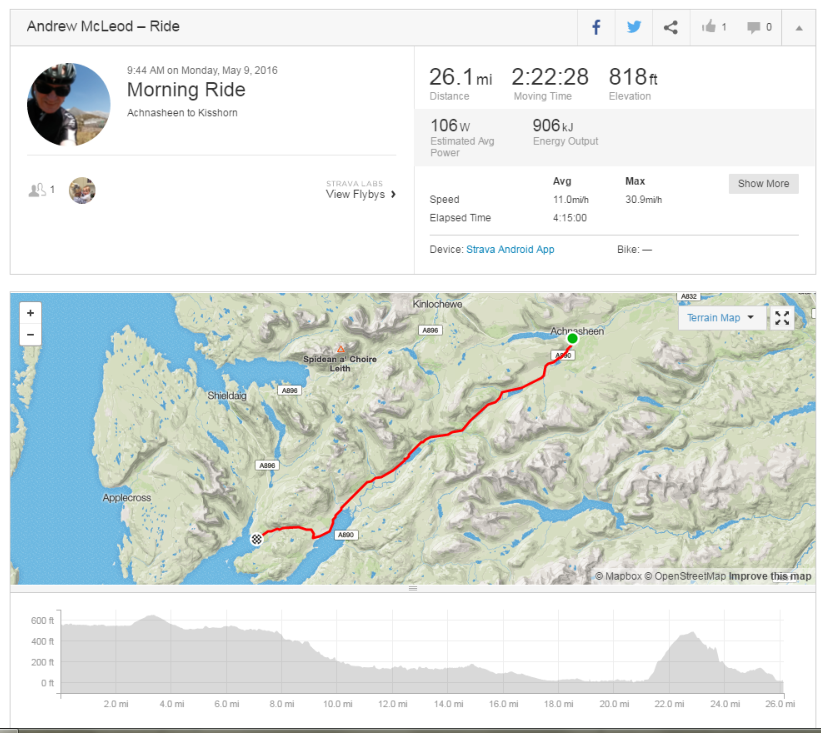
Day 2 Achnasheen to Ardarroch
 |
| Silent observers in Ledgowan Lodge |
Day 2. After a night
in the large but pleasant Ledgowan Lodge Hotel, the slightly sepulchral feel
enhanced by the watching heads of numerous stags, most of which seem to have
been shot in the 1920s by somebody with a double-barrelled name, and have thus
outlasted their assassin by a good length of time, it was time to set out in
sunshine. The cuckoo was calling at
every turn, and we saw the deer making for the high pasture as we pedalled
along. An easy ride on the A890, not too
busy, with spectacular scenery and the Kyle of Lochalsh railway following
beside. Made a mental note to take this
rail journey one day. Coffee at the Loch
Carron Golf Club, which welcomes visitors, then a hill up and over to Loch
Kishorn and a lunch at the Kishorn Seafood Bar.
This is the only place to eat, so it was necessary to pick up our
evening meal here as well before it closed at 5pm. Into the tiny hamlet of Ardarroch, where we
stayed (B&B) at the Old Schoolhouse with a lovely lady called Julia (see
Air BnB). Spectacular views down the
loch to the Cuillins of Skye
 |
| The A890 in Strath Bran. Relatively quiet and lovely in the sunshine. |
 |
| Deer heading for the high pastures after pillaging the garden of a deserted cottage |
 |
| Loch Dughaill |
 |
| The Black Cuillin of Skye from Ardarroch, looking down Loch Kishorn |
Day 3 Ardarroch to Shieldaig

Day 3. The big
one. We took it very easy on the first
two days in order to be fresh for the climb over the famous Bealach na Ba, and the
ensuing up and down ride around the Applecross peninsula to Shieldaig on Loch
Torridon. We thought this would be the
toughest day of our tour, but there were at least two harder days to come. Spectacular weather and lots of encouragement
from cars, motor bikes, and other cyclists on the Bealach. Great feeling of elation as we were greeted
by Edinburgh John at the top, playing his bagpipes, and creating a mini traffic
jam as many foreign tourists stopped to photograph him. Elation heightened by a five or six mile
downhill run to the lovely Applecross Inn, with a pint of Suilven bitter and
scallops for lunch. More great views of
the Cuillins, covered with snow as we trekked around the peninsula. Another very friendly B&B with a lady
called Sarah high above the pretty harbourside village of Shieldaig in a house called Cnoc
Gaoithe, which apparently means ‘place of the winds’.
 |
| Don't say you haven't been warned! |
 |
| The first mile is pretty easy |
 |
| Then it gets steadily steeper and leads up into the hairpins around the corner |
 |
| Fabulous views back down the glaciated hanging valley |
 |
| The steepest bit is back down below here. Pretty easy to the top now. |
Day 4 Shieldaig to Gairloch (Badachro)

Day 4. Another
dazzling day. Into a strong easterly
wind and a bit up and down until reaching Torridon where we pass underneath
Liathach (‘The Grey One’), and on past Beinn Eighe to Kinlochewe. Thoroughly recommend the Whistle Stop Cafe
here, unmistakably garish in green and yellow.
Now, on turning to cycle northwest along Loch Maree the wind is behind
us. Stopping short of Gairloch we turn
along the south banks of Loch Gairloch to reach the Shieldaig Lodge Hotel, an
impressive pile in the Scottish Baronial style with a magnificent view over the
water. EJ drives us to Redpoint, with
its fine views of Raasay, Skye, and the Outer Hebrides, cuckoos and skylarks
sounding in the evening air. Back via
the Badachro Inn, situated on the shore of a cove, for excellent pints of
Bealach na Ba and An Teallach. The theme
here is very fishing and shooting oriented.
Copies of the Shooting Times lie on the table – sample articles ‘How to
achieve Crow control’ and ‘Bunnies in the Border’ (and how to shoot
them!). Short cycling socks today equals
sunburnt ankles – not enough sunscreen.
 |
| Upper Loch Torridon |
 |
| Cycling past Liathach looking back to Loch Torridon |
 |
| The glen passing Beinn Eighe |
 |
| Incredible. More sunscreen needed. |
 |
| View of Skye |
 |
| The Torridon hills and Ben Eighe looking sourtheast from the road to Red Point |
 |
| Highly recommended beers in the Badachro Inn |
 |
| Location, location, location... |
 |
| The whisky collection at Shieldaig Lodge Hotel |
Day 5 Gairloch to Dundonnell

Day 5. ‘Another
shitty day in paradise’ as they say in California. How long can this amazing weather last? A bit of a puncheur day in the saddle, with
many short tough ascents and one or two long ones. In only 34 miles we do 3408ft of
climbing. Through Poolewe where the
river is in fact Loch Maree emptying into the sea loch of Loch Ewe. At Gruinard Bay, a cold and strong north wind
comes in and for the first time it feels chilly. The ominous island (scene of the anthrax experiments
in 1942) is easily visible offshore.
Further round into Little Loch Broom however, the breeze is gone and it
is blisteringly hot again. There are two
significant climbs here before getting over the headland to Badcaul. The viewpoint overlooking the deserted
sealoch of Loch Ewe is surmounted by a plaque commemorating the Arctic Convoys
of WWII, the ships here once so dense you could walk across the loch on
them. As one seaman said, explaining the
isolation: ‘After 6 months you start talking to yourself; after 12 months you
start talking to the sheep; after 18 months they start talking back to you.’
The Dundonnell Hotel sits underneath An Teallach near the
head of this loch. Despite, or perhaps
because of its lack of pretension, the hotel is full, mostly of bikers, with
around 30 or so very expensive looking machines outside. These are such impressive machines that
unsurprisingly, the average age of the owners is at least 45 or more – MABOMBS
– Middle Aged Blokes On Motor Bikes. The
food is good, the beer flows, and there is much talk of electronic braking
systems and BMW versus Honda. I eat a
‘Black Venison’ burger, minced venison and black pudding. They’re busy here; no wonder the hanging
baskets outside are all full of plastic flowers.
 |
| The river at Poolewe |
 |
| Loch Ewe |
 |
| Gruinard Bay |
 |
| Lunch stop overlooking Little Loch Broom, Beinn Ghobhlach and to the left Coigach |
 |
| At Dundonnell |
Day 6 Dundonnell to Ullapool

Day 6. This is Friday
the 13th. It starts cloudy
and breezy. The first and only real work
of today’s ride is the long steady climb out of Dundonnell on the A832 from sea
level to the 1100ft high pass over to the Corrieshalloch gorge, where the Droma
river tumbles between 60m high cliffs down towards Loch Broom. This is a relic of the last ice age and was
formed by meltwater from the glaciers.
Descending towards the gorge is cold on the legs – our beautiful weather
has made us accustomed to shorts. Then
we join the A835, the main road from Inverness to Ullapool. The weather steadily improves as we now
journey northwest again towards Ullapool, a major port and centre for fisheries
surveillance in the northern Highlands.
This is a short ride, so in the afternoon we all pile into the camper
van and drive to the other side of Loch Broom to walk in the sunshine opposite
Ullapool. After dinner in the Seaforth
(excellent; we couldn’t get in to the highly recommended Arch) Edinburgh John
insists we must go to see sunset over the Summer Isles. This is a long drive around the mountain
ridge of Coigach where eventually we do see the Summer Isles and watch the sun
set over the Isle of Lewis from the tiny hamlet of Reiff. There is a freezing cold northerly wind. Back to the most luxurious B&B we have
struck, a beautifully restored house called Westlea Guest House. Strongly recommended.
 |
| Corrieshalloch Gorge |
 |
| Looking up Loch Broom to Ullapool |
 |
| Unusual road sign |
 |
| Westlea Guest House |
 |
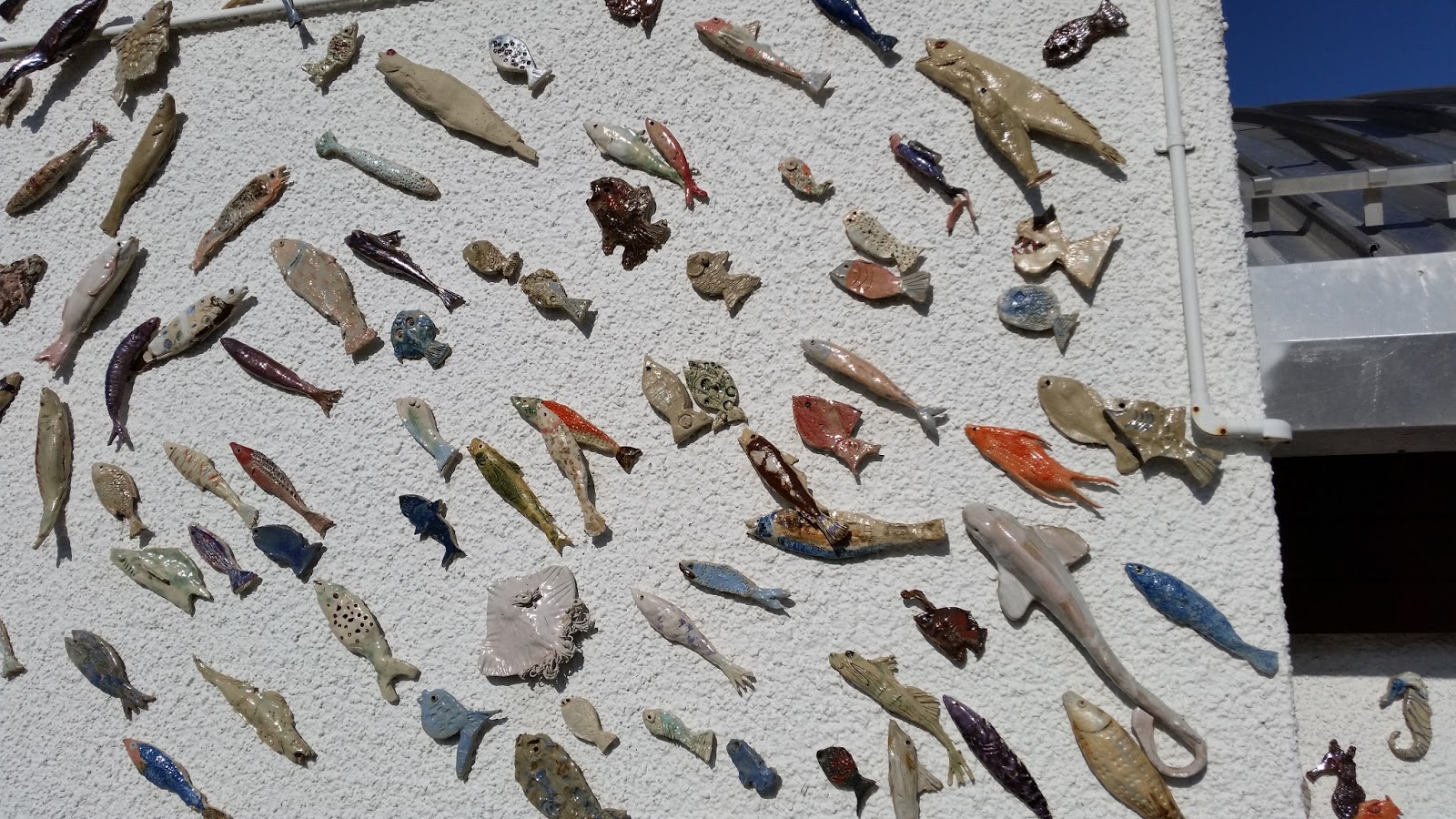
| Wall design, public building, Ullapool |
 |
| The Summer Isles at dusk, looking south from near Altandhu |
Day 7 Ullapool to Lochinver

Day 7. I’ve written
in my diary that this is ‘probably our most beautiful ride.’ But here we decided to deviate from the
official route. The NC500 just follows
the A835, but having seen the beauty of the glen behind Coigach as it winds
past two beautiful lochs and under the distinctive shape of Stac Pollaidh
mountain, we decide on what you might call the ‘back road’ to Lochinver. This involves retracing our steps, or rather
pedal strokes, to the road which leads to Achiltibuie. Cycling down towards the turn off the A835,
the cuckoo, which has once again been the musical accompaniment to our rides,
flies from an adjacent tree, straight down the road just in front of me. An unusual sighting. We pass Cul Beag and then Stac Pollaidh. Past the second remote loch the road winds up
northwards towards Lochinver. Cold as we
breast the hills into the strong northerly wind but hot in the valleys. Finally we pass through a delightful little glen, with primroses growing on every hand, a burn gurgling in the sunlight
through the middle, descend slightly, and reach the sea at Enard Bay. The inlets are small, filled with sparkling
waters and eider ducks, with little islets offshore. Lunch break with John and Glenys in the layby
at Inverkirkaig and on to Lochinver. The
driveway up to the Inver Lodge hotel is the steepest climb of the day’s
trip. Suilven, a spectacular heap of
bare Torridon sandstone peeks up from the surrounding moorland. Its shape is due to its nunatak (qv)
existence during the ice age, while the ice sheets scraped the sides below the
peak into steep sided cliffs.
Inver Lodge Hotel is a remarkably expensive hotel for the
northwest of Scotland, but it does boast a Chez Roux restaurant, managed by
Albert Roux, though M. Roux does not seem to visit that often. In keeping with its price there are numerous
staff floating around who are all very welcoming and helpful. They mostly seem to come from Eastern Europe
and Portugal... The food is indeed
excellent, including some Roux signature dishes – cheese soufflé, quenelles of
cod, lemon tart. The rooms are very
comfortable. The architecture is perhaps
best described as Scottish Brutalist style, but the elevated view over
Lochinver is fine.
 |
| We'll keep a welcome in the hillsides... (sorry, wrong country, but glad they're pleased to see me) |
 |
| The view in Coigach towards Stac Pollaidh |
 |
| Stac Pollaidh above Loch Lurgainn |
 |
| Stac Pollaidh from the northwest |
 |
| Tarmac in front, great views in the mirror |
 |
| Sparkling sunshine at Enard Bay |
 |
| Suilven peeps up behind the lochan at Lochinver |
Day 8 Lochinver to Scourie (Badcall Bay)
Day 8. There is a
change in the weather today. The wind
remains northerly and cold. The skies
are more cloudy, and there are some light showers of rain, making the campsites
at Clachtoll and Stoer look somewhat unappealing. The route is out towards the point of Stoer
to the northwest, and then northeast towards Kylesku and its beautiful Arup
designed bridge over the sealochs, opened by the Queen in 1984. The up and down nature of the coast road is
probably the toughest of the entire trip (though I find I have written this
several times). Nonetheless, through
Drumbeg there are multiple ascents along the south side of Edrachillis Bay. The steepest gradient is 25% and we have to
get off and walk, pushing our bikes up the hill. At the northern end of the Kylesku bridge is
a memorial to the XIIth miniature submarine flotilla, based here in 1943.
In the wildness of Assynt, looking back from above the
bridge, the landscape is severe and forbidding. There are no other roads in this area. The interest for me is that there is family
legend that our branch of the McLeods left the Hebrides and found their way to
Sutherlandshire, gradually moving eastwards through Assynt until they reached
the North Sea coast at Helmsdale, the town of my immediate family.
Cycling northwest again towards Scourie, over undulating low
ridges and hills of bare stone and moorland, with lochans between, we reach
Scourie, or at least Badcall Bay, to the pleasant spot of the Eddrachillis
Hotel, under recent new management. This
is a comfortable little hotel in a magnificent location. I hope they do well. The evening is fine but colder. John and Glenys are billeted in our friend
Bridget’s converted church next door, and we enjoy aperitifs beside a log fire.
 |
| Suilven from the northwest |
 |
| Distant view of Assynt |
Day 9 Scourie to Durness

Day 9. Now the
weather has really changed. It’s not
disastrous from the rain point of view, just the odd light shower, but the
skies are filled with grey scudding cloud, and as we head northeast to reach
the north coast at Durness, the wind is in our face and forecast easterly and
strong for our pedal of the 100 odd miles along the north coast to John O’
Groats. Apart from a steep hill out of
Scourie and another out of Laxford Bridge, this is one of our very easy days –
not too far, because there is no accommodation further on for many a mile. So there is time to visit the remarkable
Cocoa Mountain cafe in Durness – a must for chocaholics. There is also a pleasant walk out to the
headland in the afternoon, to watch sheep (inevitably), but also fulmars,
plovers, hoodie crows and oystercatchers.
The long inlet of the Kyle of
Durness is a wonderful unspoilt estuary.
Our last night with John and Glenys.
They take us on a surprise visit to Smoo cave and we eat at the Smoo Cave
Hotel (Orkney Ales and scallops).
 |
| Heading towards Laxford Bridge |
 |
| Glaciated valley near Laxford Bridge |
 |
| The north coast of Scotlan, near Durness |
 |
| Smoo Cave |
 |
| Smoo Cave |
 |
| The fantastic Kyle of Durness |
 |
| Glenys, John, Lindsay, me. Thank you to the support team. Smoo Cave inlet |
Day 10 Durness to Bettyhill

Day 10. Probably the
toughest of the entire trip. Oh, sorry,
did I say that before? From now on we
have all of our kit in our panniers.
Winding out of Durness, an unremarkable house boasts a plaque
commemorating the visits of John Lennon in the 1940s and 50s, sent during the
summer to relations by his Aunt Mimi. The
beautiful Loch Eriboll is not looking its best, but at least we are sheltered
from the wind, which hits as we go out from Hope and rise up into true Flow
Country heading to the Kyle of Tongue.
Ben Hope is shrouded in cloud, so we cannot see this most northerly
Munro. The Kyle of Tongue is another
beautiful inlet with views towards Ben Hope and Ben Loyal and a great descent
to an attractive low lying bridge over the estuary. Finally to Bettyhill, where we find our
comfortable, slightly rundown hotel, and enjoy the view over the fantastic
beach where some hardy surfers are still going at it in the broad daylight at
9pm. Sadly the food is not too special. Fish cakes with salmon, haddock and prawn do
not contain prawn and very little fish.
‘Seasonal vegetables and new potatoes’ are peas and chips. The lamb shank is inspissated and
inedible. The waitress agrees and we are
not charged.
 |
| EJ claims our bags are too heavy |
 |
| The spectacular beaches of Scotland's north coast |
 |
| Old chalk kilns on Loch Eriboll |
 |
| Kyle of Tongue looking towards Ben Hope |
Day 11 Bettyhill to Mey

Day 11. Probably the
toughest of the entire trip. Hmmm... We are cycling into a steady wind of at least
Force 6 strength. Including the detour
to the most northerly point on the Scottish mainland at Dunnet Head (58deg40min
N), and the overall distance is about 52 miles.
It’s grey and the undulating and rather featureless moorland seems a
world away from the spectacular west coast in the sunshine. The receptionist at Bettyhill Hotel is a
cyclist, and says that the first 18 miles are the worst. He’s right, it does undulate until one
reaches the county boundary sign for Caithness and then it’s rather flat with a
welcome break in Thurso, we break for lunch in Cafe Cardosi, an unpretentious
place in the main street which ‘does what it says on the tin.’ Caithness fields are marked with the unusual
feature of flat boundary stones, looking like slates, planted along the
edges. The grazing becomes greener,
richer, and there are now sheep and cattle.
At Armadale, Thornton’s Farm proudly boasts ‘Sheep Farm of the Year
2015’. Our destination for the night is
the Castle Arms Hotel, run by a formidable but welcoming lady called Jean. Excellent Orkney beers, e.g. Scapa Flow, and
the meal is cullen skink, steak, beef pie, lemon posset. Coastal waters forecast says continuing wind
Force 5 to 7.
 |
| The Armadale burn looking north |
 |
| Dim view of Dunnet Head |
 |
| History on the label and good beer inside |
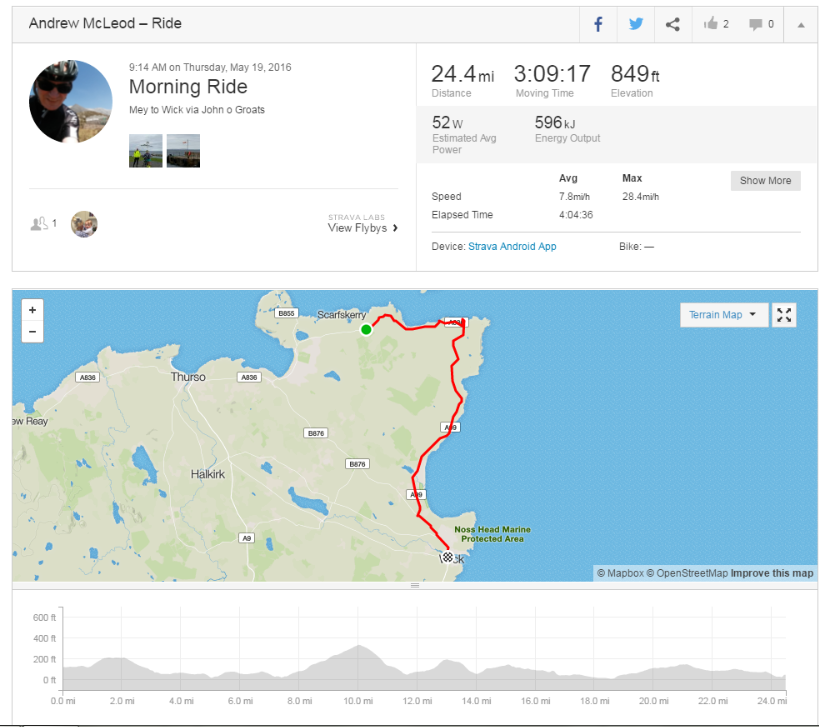
Day 12 Mey to Wick

Day 12. Not the toughest! Breakfast at the Castle Arms Hotel is
enlivened by background music of what is obviously ‘A Scottish
Miscellany’. First of all we have ‘The
Song of the Clyde’, last heard on my Dad’s Kenneth McKellar LP circa 1965. Then the Harry Lauder song ‘Just a wee Deoch
an Doris’. Strange lyrics on reflection,
which we never thought to question 50 years ago: ‘There’s a wee wifie waiting,
in a wee But an Ben; if you can say “it’s a braw bricht moonlicht nicht then
you’re a’ right ye ken”. Presumably a
Scottish breathalyser test circa 1926.
Then we are keeping right on to the end of the road (another Harry
Lauder), Westering Home, taking the Road to the Isles, and Roaming in the
Gloaming. Off we go; I wonder what
happened to my parents’ collection of 78s?
It’s only 7 miles into the wind to John O’ Groats. The windsock on the harbour is horizontal and
it’s only 6 degrees C. On southeast to
Wick, which looks gloomy in the cloud, accompanied by occasional showers. Lunch at Morag’s in the town is
adequate. We’re staying at Mackay’s
Hotel, a rather commercial affair, and the food is not particularly good. The wrong meal is brought twice.
 |
| A bleak scene but great to be here |
 |
| Note the windsock. Orkneys in the background |
 |
| It's a hard life and he doesn't get much for those crabs and lobsters |
 |
| Cycling up the hill away from John O' Groats |
Day 13 Wick to Helmsdale and around Helmsdale

Day 13. Take a turn
around Old Pulteney, the old area of Wick near the harbour. A hot spot in the 1860s with numerous taverns,
brothels, and a harbour so full of the herring boats that you could walk across
the water without a bridge. Now it needs
some regeneration, but down at the harbour I do find the offices, well, shed,
of the North Highland Initiative. Now
we’re on the A9 and remarkably into the wind again which seems to have backed
to the southeast. Through little
villages with names like Ulbster, Thrumster, Lybster. Berriedale Braes is a long and severe climb,
but we reach Helmsdale in bright sunshine.
Strangely the lovely building which is the Navidale House hotel doesn’t
open until 4pm. This old fishing lodge,
previously a hunting lodge of the Dukes of Sutherland, was superseded when the
local estates began to arrange their own accommodation. It’s now run by a chap from the south
(Blisworth in Northamptonshire), whose wife is an award winning chef (we
agree). So there is plenty of time to
search for my heritage in the town. The
only trace we find is Uncle Johnny from the 1930s, who ran an electricity
company, and so family legend has it, sold out to the National Grid and drank
the proceeds. He’s listed in the local
trades archive. Helmsdale is markedly
improved from my last visit some 50 years ago; a fine museum; a fine statue to
the dispossessed of the ‘Highland Clearances’, and an attractive little
harbour. The river of course is prime
salmon fishing territory.
 |
| A gloomy Wick harbour. In the 1860s this was full of skaffies |
 |
| This gives some idea of Wick Harbour in the 19th Century - the busiest herring port in Scotland |
 |
| Approaching Helmsdale on the A9 |
 |
| The Emigrants - a striking memorial to the dispossessed of the Highland Clearances |
 |
| The bridge and the river, Helmsdale |
 |
| Helmsdale Harbour |
 |
| The small course and tiny clubhouse where my father learned to play in the 1920s |
Day 14 Helmsdale to Tain with detour along the Dornoch Firth

Day 14. We are the
only guests at the hotel, though late tonight some musicians who have come up
to play with the reclusive pop star Edwyn Collins (A Girl Like You) in his
recording studio at Navidale are expected.
Some of them appear at breakfast, looking somewhat the worse for
inspirational enhancing substances. On
south. The A9 takes us to Brora, through
the rain, and we break in Poppy’s Cafe, a welcome stop, in the middle of
Golspie. After rounding Loch Fleet on the A9, we depart from the official route
for a longer but much more attractive journey through Skelbo, watching the
eider duck and shelduck into Dornoch where it really rains hard, and Harry
Gow’s cafe by the cathedral is a very good stop for lunch. Out to the fantastically located Royal
Dornoch Golf Club with its views over the Dornoch Firth. A little road out through Cuthill allows us
to stay off the A9 until the bridge over the Firth. On our route today, the infamous statue to
the Duke of Sutherland atop Beinn Bhraggie above Golspie dominates the
landscape. A key figure in the Highland
Clearances, George Granville Leveson-Gower, first Duke of Sutherland, has ‘his
back to the lands from which he drove his people and his face towards the sea
to which he condemned them’.
But light relief.
There is an open weekend at the Glen Morangie distillery in Tain. Pipe band, free cheeses, seafood, ice creams,
and crucially, whisky. Excellent tasting
of ‘The Signet’, Glen Morangie’s flagship whisky. Fortunately our hotel is not far away...
 |
| Dornoch Cathedral |
 |
| What to do in Dornoch when it rains |
 |
| The statue to the Duke of Sutherland on Beinn Bhraggie |
 |
| Royal Dornoch Golf Club |
 |
| The Dornoch Firth |
 |
| Glen Morangie's finest whisky |
 |
| and matching Cadillac |
Day 15 Tain to Muir of Ord with detour onto the Black Isle, North Kessock, and the Beauly Firth

Day 15. The Morangie
House hotel is, like so many Highland hotels, a little tired. It seems to be owned by Swallow Hotels of
Preston who clearly aren’t putting funds in to make it top notch. But the staff members are friendly and
helpful, and the food is fine. From Tain
we decide to follow a Sustrans route to avoid as much as we possibly can of the
A9, until we have to join it to cross the bridge over the Cromarty Firth. The A9 remains a huge drawback to cycling the
NC500. The poor road surface in many
places means the noise of the passing cars and lorries is deafening, and many
of them exceed the speed limit. I lost
count of the number of cars who think it’s acceptable to cross a double white
line at high speed if they are only overtaking a bike. But on our little road along the Cromarty
Firth we enjoy beautiful sunshine and lovely views, including oil platforms
being prepared for sea, and the deep water port at Invergordon where a large
German cruise ship is moored. All ashore
for the Highlands, the odd distillery and Dunrobin Castle. Onto the Black Isle where we detour around
just for the fun of it, and also to take the tiny road over to Munlochy and
thence to North Kessock so we can perambulate along the Beauly Firth on tiny
roads to wend our way back to Muir of Ord, and our final night in the excellent
Dower House. A spectacular shower of
hail greets us as we cycle along the Firth, but it’s gone in an instant the
sunshine afterwards is wonderful giving us a final view of Scotland’s
beauty. Super food and a farewell meal
with our friends Kevin and Heather Jennings.
In the morning we will load the bikes and drive all 630 odd miles back
to Poole. We’ve certainly taken our time
to do this route – many others will do it much more quickly, but it was an amazing
experience. Our route comprised 540
miles and 38,000 ft of climbing. But any
journey that’s attractive is worth doing – slowly. Over to you...
 |
| The unusual Kildary Kirk, Cromarty Firth |
 |
| Cromarty Firth panorama, looking at the Black Isle |
 |
| Cromarty Firth |
 |
| On the Black Isle |
 |
| Final view, Beauly Firth after the hailstorm |
 |
| Back where we started, the Dower House, Muir of Ord |