Sunday, July 15, 2012

Travels in the Far East - of England


How to visit the Far East without leaving Britain

Yes you may have guessed at this somewhat jokey allusion – the East of England, or at least Suffolk.
Willy Lott's Cottage, Flatford

Saturday 29th June.
After a somehat frustrating day at Wimbledon in which Lindsay manages to lose her phone, and we have to leave before the end of the Federer vs Bennetau match because of a timed rail ticket, we start early and fix our new BMW bike rack to the tow ball of the X3.  The rack is the most impressive piece of German engineering and is rock solid.  It comes complete with its own lights and light connection.  Of course it costs a fortune, but will be perfect for ever so long as we own a BMW with a tow hitch.  Off to Essex.  Reasonable journey despite the heavy traffic and arrive in Langham, at the house of Paul Armstrong, whose company, Coolpedals, is coordinating our trip.  Paul, or Mr Cool as we have named him is a fairly typical keen biker.  His website says ‘plenty of off-road parking’ so we miss the bungalow first time around as we drive along his road.  More a bungalow industry than a cottage industry then.  Equipped with maps and with a GPS affixed to the stem we are off up the Box valley and down the Brett valley – a rather roundabout 18 mile route for getting to Dedham, which is our first night’s stopping point.  Dedham is in fact only 3 or 4 miles as the crow flies from Langham.  A breezy afternoon of open skies and fields, breezy, and sunshine, tiny streams and short steep descents and climbs.  An unconcerned partridge looks at us from the opening of a wheat field.  We miss Milsom’s Hotel as we cycle past and detour into Dedham for a quick first look at Constable country.  JC was born nearby in East Bergholt, and many of his landscapes include Dedham Vale, or the church, the building of which was started in the year Columbus discovered America.  One of Constable’s only 3 religious paintings, an Ascension, is in the church.  It’s a somewhat unimpressive imitation of many Renaissance pieces, and we are sadly underwhelmed by it.  Apparently the purchaser defaulted on payment and Constable is not thought to have worked too hard on the lower half.  Good job he stuck to landscapes.  In fact he was only modestly successful during life, despite his admittance to the Royal Academy.  For example he sold more paintings in France than he did in England.  Curiously, during the week we are in Suffolk and Essex one of his paintings, ‘The Lock’, sells for about £28 million.  Xerxes would rather like to visit his grave, but unfortunately that turns out to be in St John-at-Hampstead in London.  Of more interest in the church are the tablets recording the passing of its residents or their relatives, in the great era of colonial expansion.  One inscription which catches my eye is a plaque dedicated by a widow to her late husband, the final line of which states something like ‘… this stone was caused to be placed by his affectionate relict.’  ‘Would you be my affectionate relict?’ I ask Lindsay.

It’s a lovely warm afternoon with big skies over Dedham Vale and typical Constable fluffy white clouds in the skyscape, so we are not sorry that we cycled past Milsom’s.  We’ve booked in at Le Talbooth for dinner, and this is excellent, Michelin star standard cooking, with a wine list to match, although, understandably, not cheap.  In fact it’s the most expensive meal of the holiday, but the value of the pub and hotel food that we find after this is pretty good.  After an initial celebratory glass of Moet we select a Thelema 2007 Cabernet Sauvignon, which is gloriously smooth and rich.  The choices we make include pigeon, rabbit, scallops, ham hock terrine, lamb, venison, fillet of beef.  On return, Murray vs Bagdatis is still in progress at Wimbledon and sets a record for finishing at two minutes past eleven.  The first day of Le Tour (de France, not Suffolk) features Cancellara as the winner of the time trial.

At Le Talbooth, the bridge marks the old boundary between Essex and Suffolk, crossing the river Stour.  Around us on the terrace (it’s a lovely warm evening though space heaters are also needed as night draws on), Essex man is in his element, distinguished by open neck shirt and tan, and Essex woman is also on display, distinguished by short skirts and teetering high heels.  Mercurey Premier Cru is going down well at the table next door.
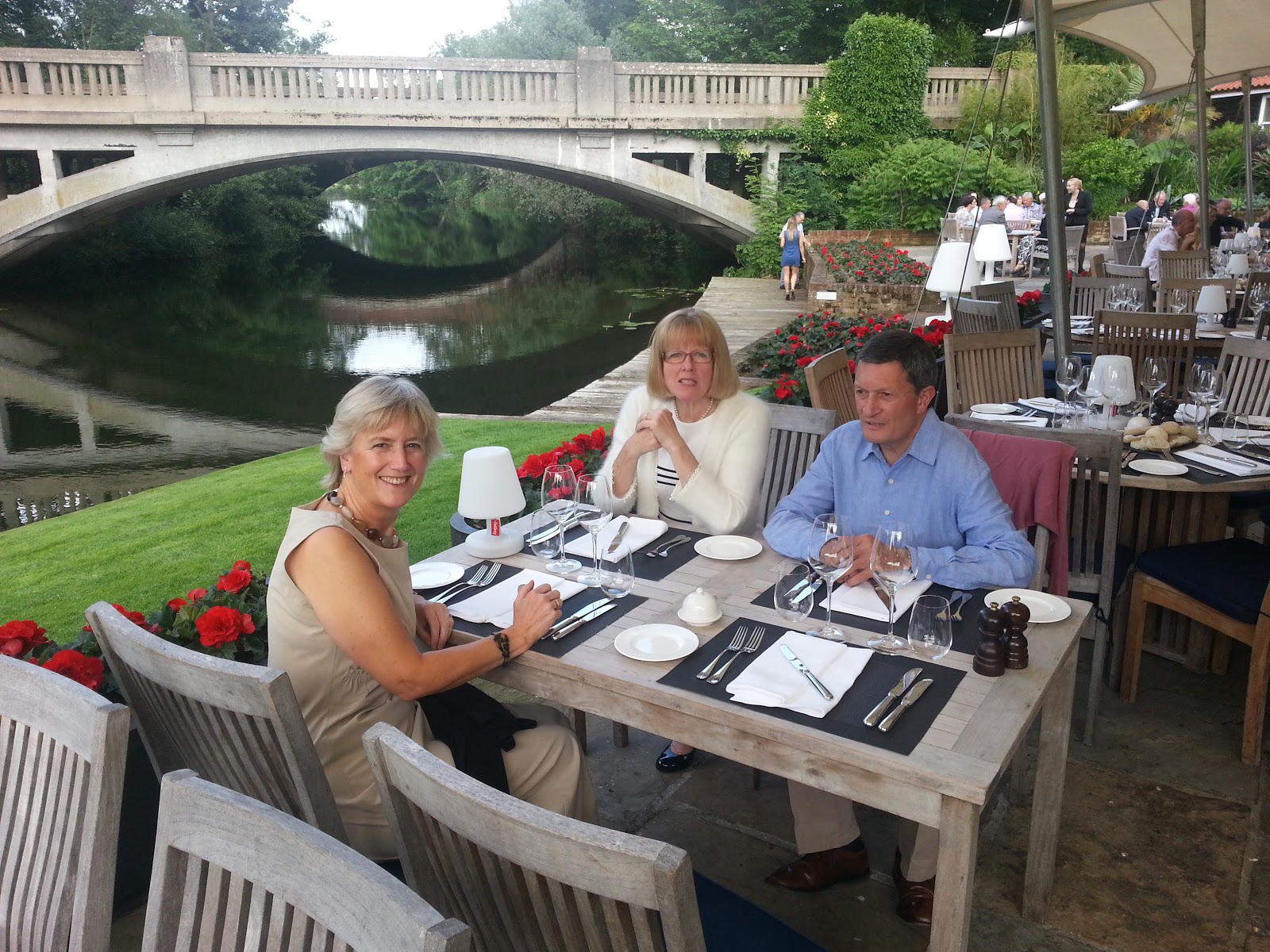
Le Talbooth

Sunday July 1st.
 A long ride ahead so breakfast at 8 and on the road at 9.  Back into Dedham and then a roundabout route to East Bergholt with its beautiful old church and unusual bell cage.  Then down to Flatford Mill, Willy Lott’s cottage, etc, the scenes of Constable’s most famous paintings.  Unfortunately one wouldn’t really recognize the ford and there is no haywain.  There is a long diatribe in the visitor’s book about the building of the tea rooms which apparently prevents one from observing the ford and bridge as Constable might have seen it.  The atmosphere is peaceful and it is sunny and warm.  Roses on the red brick walls, more fluffy white clouds, a swan on the pond.  It’s the front of a chocolate box or perhaps possibly a jigsaw.  In fact, throughout the trip there are many scenes that remind me of my childhood jigsaws –‘Now does that yellow rose go there by the wall or is it part of the one by the gate?  Shall I start on the thatched roof, or are there too many pieces to get into it first?’

Chocolate box scenes
East, along the Stour, towards Shotley.  Detour around the massive Royal Hospital School, then past the church at Erwarton, where legend has it that Anne Boleyn’s heart was secretly buried, and indeed a heart shaped casket was found there in 1838, set into an alcove in the church…  Erwarton Hall next door is a magnificent 16th century manor house.  We stop in the pub before Shotley and enjoy excellent pasties, before cycling on a rather bad (footpath) route to Shotley itself and its marina.  I’m told that we must have cycled past Griff Rhys-Jones’ cottage, but we didn’t see him…
Erwarton Hall

It’s a very windy grey day and it’s easy to spot the rather peculiar shallow draft ferry that is buffeting its way towards the dock.  It’s a truism that all professional mariners grumble, and the crew of the Harwich, Shotley & Felixstowe ferry are no exception.  There is a sign in the wheelhouse which says ‘We hate tandems’, and this is not surprising because the arrangement for bicycles is a sloping bow section which has wheel racks for six bikes.  Then they are lashed down, and with us and a few tourists plus dogs we set off.  The crew of two are accompanied by a third who turns out to be the engineer.  The very substantial diesel engine is purring beautifully under the floor.  To try to cheer up the morose skipper I remark on this.  ‘Bloody miracle it goes at all’ he says.  ‘The man who services it is standing next to you and he retires next week’, he adds gloomily, looking reproachfully at his colleague.  The other passengers have two dogs.  The Alsatian doesn’t look too keen to come aboard and stands uncertainly looking as though it is going to be sick at any moment.  The dim owner decides this is the time to try it with a grape, but neither the Alsatian nor the lapdog is keen.  At least they have more sense than their owners.  Fortunately they alight at Harwich quay.  Xerxes has assured me that Harwich is a lifeboat repair centre, but since there is only one lifeboat visible and there are a surprising number of lightships everywhere he recalls suddenly that it is for lightship refits that Harwich is famed.  We set off again for the Felixstowe shore.  This time it’s straight into the chop and salt water comes over the bow and onto the bikes.  At last we discover that the landing craft morphology of the ship’s bow is there for a reason.  The helmsman just drives the boat into the beach.  They slide a gangplank from the bow of the vessel and we gingerly wheel everything ashore.  This method obviously can only work because the beach shelves steeply, and the stern and the prop remain in deep water.  We still have one more ferry crossing to make, the so-called Felixstowe ferry, though it is somewhat north of Felixstowe and crosses the River Deben.  On the Shotley crossing the crew warn us that the skipper of this boat is ‘short, sharp, and miserable’.  The contrary proves to be the case, unsurprisingly because John the ferryman proves to be quite genial, and he charges about twenty times as much as the Shotley ferry’s charge when calculated as distance run.  ‘Oive got an ‘ernia’, he says as he watches us struggle with lifting the bikes over the rail of his boat.  He is as brown as a berry, with a piratical ring in one ear and curly grey hair.  In costume one could imagine him as a seadog of Nelson’s time, though in merely taking passengers across the river mouth he has a somewhat easier time of it.  Prior to the Deben we pedal along the seafront at Felixstowe which reminds me of Bournemouth, but Lindsay finds it enchanting, and I suppose that it is somewhat more genteel than Bournemouth.  Large tankers and container ships pass offshore, and there are glimpses of the treacherous sandbanks which lie far out to sea.
The beach at Felixstowe

The piratical John, and his crew.  River Deben, Suffolk

The route to the Felixstowe ferry takes us through the golf course to the north of Felixstowe, and having made the two minute crossing of the river mouth, and handed over the sum of £14 to the cheery John (perhaps our former shipmates were jealous of his comparative earning capacity), our route lies along the north side of the estuary heading inland in a Westerly or Northwesterly direction.  Our route from Mr Cool detours us to Ramsholt, a pretty sailing village on the side of the Deben, where we get lost trying to follow his off road directions, but eventually return inland to the ‘B’ road, and give further diversions a miss, because it is getting late.  Regretfully we give Sutton Hoo a miss, and having crossed the river from Northeast to Southwest bank we strike a bridleway inland and emerge in the little village of Melton, which is more or less conjoined with Woodbridge.  Leaning on the wall of St Andrew’s church, sitting on my bike saddle I can see a vicarage tea party taking place.  The vicar, in that type of soft hat, and down-at-heel jacket over a black clerical shirt that only vicars seem to manage to acquire and carry off successfully, sees me waiting for the others and calls us in for tea.  A wonderful opportunity to use the Tony Hancock line, ‘More tea, Vicar?’ and we don’t need much compulsion after 50 miles in the saddle.  The price for his strawberry cream tea is a modest £5 a head, with unlimited tea, a piece of fine cake, sandwiches, and a scone with jam, cream, and strawberries.  How they will ever make enough for whatever it is they are saving for I don’t know.  This providential experience is just what we need.  The vicar warmly invites us to stay on for the multi-denominational service which is to take place later, but he is a bit nonplussed when Philippa plays a masterstroke and announces that Xerxes is a Zoroastrian, being Parsee, and admits that he is not sure that this has been included.

At any rate, it is now getting quite late and we still have a couple of miles to pedal into Woodbridge where after a short delay, we find the B&B, St Anne’s Schoolhouse, located in a secluded road just behind the main street, and only yards from The Crown where we have booked for dinner.  After dinner, which is good, the others forage around the boutiques of Woodbridge, but I return to catch the end of Euro 2012 (Spain 4, Italy 0).  Paper, diary and bed.  Over 50 miles and 2600 feet of ascent and descent.
The Deben
Monday 2nd July.
Very tired last night and slept well, despite rain occasionally drumming on the Velux windows.  Today is not such a long itinerary, about 36 miles.  We cycle north then east, sandy and gravelly woodland trails, separated by some open land with piggeries, and subsequent fields immaculately planted with pink flowering potatoes, to the pretty village of Orford, low-lying, grey, and gusty, with its boats rocked by a howling wind.  There is a welcoming café, for drinks and a cake.  It has a castle and a famous oyster shop called Pinney’s.  Leaving here, it’s an enjoyable ride along small lanes on the ‘Suffolk coastal cycleway’ up to the top of the Alde estuary at Snape, the famous Maltings and concert hall.  It is sunny and warm when we get here, though breezy still, and we wander the grounds admiring the sculpture (if that is the right description) by Henry Moore, Alison Wilding, and Barbara Hepworth.  In the distance, I can see a few families admiring a Suffolk punch horse and cart, no doubt waiting their turn for a ride.  We do not visit because we are anxious for lunch, but I discover now I am writing this that it is actually a painted bronze statue by Sarah Lucas!  The fish soup in the Plough and Sail pub is excellent.  Then it is back towards Woodbridge and Lesley’s excellent B&B, but first we have to negotiate some more forest tracks which are becoming muddier.  Eventually deciding that tractor ruts and deep grass were not for us we detour via Wickham Market to come down into Melton via Ufford.  A good dinner at the very traditional ‘Ye Olde Bell and Steelyard’ pub.

Tuesday July 3rd.
We leave Woodbridge sharp at 9am.  The rain has drummed on the Velux windows during the night but it is only grey above us as we cycle down to the Deben, and then turn up Martlesham Creek, with remote and beautiful mud flats, the cries of burbling curlews in the air.  Across the dam and sluice at the top; it is not so funny of Mr Cool to give us a route up through the woods which involves carrying the bikes up steps.  Meandering through small roads we eventually track onto the main ‘A’ road which crosses the Orwell South of Ipswich.  Finding the bicycle route is tricky and the track beside the main road is covered with debris.  The screaming of cars and lorries beside us on the other side of the crash barrier is unnerving, but we lift our bikes over the bank at the end of the bridge and join a small road towards Woolverstone.  Pedalling past the magnificent Woolverstone Hall, aka Ipswich High School for Girls, we take some small roads and tracks, crossing fields of pink flowered ‘Maris Pier’ potatoes, down into the picturesque village of Pin Mill, scene of two of Arthur Ransome’s books for children in the ‘Swallows and Amazons’ series.  It is the ‘Butt and Oyster’ which claims our attention, and Lindsay, first inside, finds us a lovely table in the window where we can gaze out at the yachts and the few remaining Thames barges which still ply the river.  The beer is welcoming and fed by gravity feed, and the food is good.  Xerxes’ sea bass in paper looks excellent.  The fish stew and Philippa’s roll mops are good too.  Regretfully leaving PinMill, it is quite a steep haul up to the top of the peninsula where we cross to the other side and back to the Stour.  Around Alton Water again, this time on the east side, we move inland and gradually make our way to a disused railway track which takes us into Hadleigh.  Unfortunately it is another five miles in drizzly rain, our first real encounter with it, to Stoke by Nayland, arriving at The Crown, where we have lovely rooms and the misery is forgotten in the bath and the warmth of the white fluffy robes.  A good dinner – but I don’t remember it.  We have done 52 miles and experienced three punctures, the last one of which was in my back tyre a mere half a mile from the Inn.

Wednesday July 4th.
The breakfast at the Crown is a gourmet one, which has to be ordered, so delays us a little, though pleasurably.  French toast, eggs royale, etcetera.  We leave to the West, going downhill past the church on a tiny track.  A circuitous route around Stoke by Nayland golf club and a longer detour because of a closed road, and then I have yet another puncture.  On a stone concrete hard standing outside somebody’s house, it turns out that the owner is indoors, and far from being offended he offers us coffee and biscuits.  Moving on through small roads our final route into Lavenham is along the inaptly named Clay Lane, which is neither of clay, nor yet a lane.  It is a muddy track, our wheels becoming caked with mud, and we have to stop several times to clear Lindsay’s mudguards with a stick.  Careering along, rather too audaciously, eventually my wheels slip suddenly sideways and I am off my bike, through the nettles and into the ditch.  A few scratches and grazes, but fortunately no damage.  There has been sufficient nocturnal rain for us now to decide to avoid Mr Cool’s tracks altogether, and to find substitute routes, preferably on small roads, which avoid them.  In addition the extensive rains in June have increased the grass and nettle cover alarmingly.  Arriving in beautiful Lavenham we are able to sit in the sun opposite the Guildhall and outside the Angel Inn.  An excellent loo allows me to clean the mud and blood off, and some beer and a light lunch from the Marco Pierre White menu makes us feel better.  We visit St Peter and Paul church, Lavenham’s famous landmark (late perpendicular; built 1485 – 1525) and pedal on to Long Melford.  Then West to Liston through idyllic pastoral countryside, full of meadows, brown cows, ponds, rushes and swans.  The edges of the roads are decked with wild flowers and purple mallow.  On small roads, we eventually reach the George at Cavendish.  Our only disappointment of the trip is that Lindsay and I have a disappointingly small room instead of the one that we have paid for.  However; off to Water Street, where Xerxes’ cousin lives.  Firoza, and her husband Geoff, provide us with Crémant de Bourgogne and then we retrace our steps to the George, where the landlord, obviously feeling guilty, provides us with a bottle of house wine – a not too generous recompense.  After this though we order a decent bottle of Chianti Classico, so the house wine becomes a distant memory.  Good scallops and langouste, steak, chocolate mousse, and bed.  A route of about 38 to 40 miles to get here.
The Guildhall, Lavenham

Thursday 5th July.
This is rather a noisy location.  The traffic starts going by just after 5 am, so the window has to be closed.  The breakfast is good.  We start by retracing our steps, or route, before heading North in a big anti-clockwise loop.  Unfortunately two more punctures in Philippa’s front wheel and another slow puncture in my rear wheel lead us to feel that we need a bike shop and some new tyres.  A low point is reached as we pass through Steeple Bumpstead towards Hellions Bumpstead where Xerxes remembers attending a wedding, and there is a pub.  Sadly the pub is closed, as are quite a few of the old country pubs.  On into another village which fortunately has a shop.  Drinks and ice cream are all that is available, but they are welcome.  As we travel on Xerxes remembers that the wedding wasn’t here after all.  Surprisingly I feel no sense of enmity towards him, realising that all of our memories of our youth are pleasant, but fickle.  The pub’s loss was also the village shop’s gain.  Passing on into Saffron Walden, a town with a pretty centre is distinguished for us by finding a wonderful bike shop in Hill Street, Newdales, with a real expert in charge, and yards away, the popular tea shop, Cou Cou’s.  A remarkably short time later, and Philippa and I now having puncture resistant tyres, we confidently travel on past Audley End House, then South, then West, and finally South again to the Cricketer’s Inn at Clavering, a distance of about 38 miles.

The Cricketer’s is well organized and we are in a separate building with smallish but very adequate rooms.  The keys come attached to a beautiful new looking genuine 5½ ounce cricket ball, so it is unlikely that one will decamp with them.  The food is good and the pub is busy.  It’s a lovely evening.  People are sitting outside and there is a beautiful open top Ferrari sitting next to an equally immaculate Morgan.  Inside, more Essex man, a somewhat pluffy (as my mother would have said) young man in jeans and white T shire with a very shapely blonde in full Essex war paint, and pencil slim white sheath skirt and leopard print top, the obligatory heels visible underneath the table.  They order ‘blush’ wine…  Unfortunately we don’t get to meet Jamie Oliver’s parents, for it is they who own and run the Cricketers.  (A note for our transatlantic friends – Jamie Oliver is a TV chef, big on personality and Essex/Cockney style familiarity.  He has, unlike others, tried to tackle issues as diverse as restaurant unemployment and school dinners.)

Friday 6th July.
At last we get to meet Trevor Oliver, Jamie’s dad, for it is busy at breakfast and he is obviously drafted in to help where he works busily waiting tables.  He’s an easy-going, friendly man, and sounds just like his son.  His breakfast sausages are fantastic – almost pure meat – so we engage him in conversation about them.  He’s proud to tell us that they make them on the premises, ever since his butcher retired.  Trevor manages to insert the interrogative ‘Yer know what I mean’ in a terrific Essex accent at least five times in the space of two minutes.  Jamie’s TV training has obviously cured him of this habit.  Another table is occupied by an entirely Asian group of young men, about 12 in all, and one woman, who are recovering from attending a wedding.  Despite the now steady drizzling rain outside most of them are wearing dark glasses, and either still intoxicated, or more probably trying the imitate the dancing shambling gait of a rapper, or as I still think of it, the style of ‘Huggy Bear’ in the Starsky and Hutch TV series (Oh dear, dated again!).

The rain is now a rather steady drizzle, but there’s nothing for it but to saddle up and pedal off.  We shorten our route to about 36-38 miles, and avoid any off-road.  As the drizzle intensifies, Xerxes is wondering where we can stop for shelter.  The first point is in fact under the helpful roof of an underpass under the M11, but a rather more attractive stop is in the tiny village of Henham, where our attention is drawn to the Church of St Mary the Virgin by the fantastic pealing of the bells from the tower.  Having ascertained that this is not for a wedding we creep inside and spend a few minutes of sanctuary here.  It would be nice to know what the peal is, for it is certainly being very evenly rung, and dare one say ‘appealing’.  A notice says, ‘Do not disturb, peal attempt in progress.’  I am making enquiries as to the nature of it and if I should discover I will append it to the blog.  Who can forget the sinister implications of change-ringing in Dorothy L Sayers’ famous detective thriller, ‘The Nine Tailors’?

As the rain relents again to a drizzle, we reach Thaxted, which we instantly like.  It has a fine curving High Street, and a coffee shop and bar called ‘Parrish’s’.  A hot chocolate is required, a little bit like stopping for a break on a ski run.  Wandering up to the church, we stop at the South door.  From within come the strains of Bach’s Partita No. 3, played on the organ.  Coming around the church to the North door which is open, we find Alastair Sampson, retired organist of Eton College, practising for a Saturday evening concert.  At the end of the Bach, he explains that he has to play some Holst (who lived in Thaxted from 1917 to 1925) for local interest, and regales us with an unusual Chaconne, which is apparently transcribed from a military band arrangement.  Now we strike out to the East on our own route, bypassing Mr Cool’s off-road plans, and reach the attractive village of Finchingfield, another place which looks like a chocolate box cover.  In fact, Philippa announces that in her mother’s pictorial needlework days, she once created exactly the view we are seeing, looking across the duckpond up at the whitewashed cottages and up to the church beyond.  The Fox pub beside us is conveniently located for lunch and by the time we come out, the rain has gone and it is hot and sunny.  Our last 16 miles are run in the sunshine and we trundle into a little place, confusingly also called Audley End, in the village of Gestingthorpe, where we stay at The Pheasant, in rooms in their large and well-appointed recently restored coach house – the Thomas Gainsborough and the Mark Catesby rooms.  Now that we have time to dry out a bit and relax, we can watch Andy Murray beat Jo-Wilfrid Tsonga in four sets.  The first British finalist since 1938 (and the rest is recorded history as you are well aware from the following Sunday).  The meal is excellent, tempura prawns, lamb, and tarte tatin.  Complimentary glass of prosecco is a nice touch, and a bottle of Australian Wooloomooloo!

Saturday July 7th.

It’s rained again, but no major problem pedalling eastwards towards Langham.  Maybe it’s the home journey awaiting us, but it all seems less magical, even passing through Halstead, a finalist in ‘Britain in Bloom’, where we didn’t see much in the way of Blooms.  Out towards Colne Engaine and other small villages.  Xerxes has a puncture – his first – and he is somewhat indignant in view of his ‘puncture proof’ tyres, so Lindsay with her Kenda ‘puncture resistant’ tyres ends up as the only one not to have suffered one.  We stop for a drink in Bures, at the rather grubby pub, where one particular area of the leather banquette seating has been destroyed by the claws of the large Labrador which habitually lies on it.  Good beer though.  The best of the week in my view was the Old Growler from the Nethergate Brewery, Stour Valley, based in Pentlow, Sudbury, and an area we have cycled through, though the Adnams and the Greene King were also very acceptable.  Cycling on through Bures, it is late Saturday morning, very sunny and remarkably, even suspiciously, quiet.  One expects to turn a corner to see Clint Eastwood, clad in a poncho with a cheroot, walking lazily down the middle of the street.  It’s strange how some places in Essex and Suffolk seem like this, and others are busy and thronged with traffic.  After about 28 miles we finally bypass Nayland, do a few steep ups and downs, and return to Langham.  We say hello and goodbye once more to Mr Cool, and it only remains to load up and to return to the rain of Dorset, which starts in an unrestrained fashion at Basingstoke.
Potatoes

Poppies

Village sign

Audley End House


Epilogue:
The week moves on with most of the usual chores, so many things seem to go wrong.  Lindsay’s phone arrives and the SIM is wrong, one of the gates fails to open (it seems that a slug became fried on the motherboard – expensive pest killing), the Satnav is broken and has to be replaced, the 24 hour ECG recorder is not working and a new lead is sent but doesn’t fit; the computer expert has to come and fix the computers, there is a water leak in an upstairs room from an old chimney, etcetera, but the end of the week (Friday 13th) brings inspiration and enjoyment when we go to watch our friend Morag Day run with the Olympic Torch in Winton near Bournemouth.  The surroundings are prosaic, but at least it means a huge and enthusiastic crowd.  And we always have the evening running of the Tour de France highlights to enjoy, especially with our boy Bradley in yellow.

Lindsay gets into the spirit of the torch relay...
Morag awaits her moment

The run

Monday, April 23, 2012

The Scottish Medical Golfing Society

THE SCOTTISH MEDICAL GOLFING SOCIETY


Subtitle: Rye - with no mention of Henry James, Radclyffe Hall, and E F Benson
The current blog is an unashamed ‘puff’ for this venerable society, which is very much an endangered species, only eleven members attending the AGM meeting in Rye, and only eight remaining to do battle with the Rye club members on the Sunday morning.  Despite having a large number of members on the subscription list, a minority still play.  It has been suggested that any internet activity might be helpful in increasing the profile of the SMGS in our search for new members.  So here goes...
The birth of the society came to public attention in the correspondence columns of the British Medical Journal on June 9th, 1934.  Those who wish to read the original will find it at:
The first president was Bertram Shires.  The entrance fee was one guinea and the subscription one guinea per year.  The aims of the society were concisely stated:
‘On April 30th, 1934, a meeting was held at the Langham Hotel for the purpose of giving concrete form to a common desire that Scottish members of the medical profession in the London area should meet occasionally throughout each year for the express purpose of vying with one another in propelling the golf ball from tee to hole, according to the rules of golf.’
There followed an impressive list of vice-presidents, treasurer, secretaries (plural), and councillors.  One of the councillors is given as L E Barrington Ward.  Later Sir Lancelot Barrington Ward, this famous surgeon is thought to be the character on whom Sir Lancelot Spratt was based in the book and film ‘Doctor in the House’.  He was certainly a surgeon at St Bartholomew’s Hospital, which was attended by Gordon Ostlere the author, who adopted the pen name of Richard Gordon.
The BMJ was definitely different in those days: the next two letters deal with alleged poisoning by ground ivy and ‘Tests for Drunkenness’ in which, ‘J.P’, a police surgeon, provides a foolproof defence for anybody accused of being ‘drunk in charge of a car’.  I can’t see the present editor of a journal which now takes itself very seriously allowing us column space to push for members, but we are going to try it.
The first golfing meeting of the society was held at Hadley Wood golf club later in the same year.
A number of factors have combined to threaten the Scottish Medical Golfing Society.  When I first joined the society in the mid 1980s, there was a fine selection of Scottish doctors from the Home Counties, and we counted pathologists, coroners, surgeons, physicians, and general practitioners among our number.  GPs made up the backbone of the society, and their contract favoured the meetings of the society because most of them had a half day off during the week, and they were able to extend this to a full day by doing a Saturday morning surgery in lieu of this extra time.  Changes to the contract spelt the death knell of this relaxed and sensible system.  Under the ‘new’ contract, which came about some time in the 1990s, it became mandatory for GPs to be present in surgery on every day of the working week.  Further changes in their contracts have not been conducive to improving this situation.  But another and more important factor is the parochialism of the current system of medical training.  Registrar rotations are now organized such that only local graduates stand much chance of being accepted into their local deanery training rotations.  Scottish graduates are thus an increasingly rare sight south of the border.  At the time when I was seeking middle grade training (what Americans and Canadians would call ‘residencies’), jobs were sporadic, few and far between, and could be as far afield as Inverness.  The Society exists for Scottish doctors (who may have graduated elsewhere) or for doctors who graduated at Scottish medical schools and universities.  It is becoming increasingly uncommon to find Scottish doctors in any posts ‘down’ here in England.  We either need better publicity or an influx of Scottish doctors to the Home Counties.
In considering publicity, our new website will we hope improve our profile, and it is available at:
Unfortunately, if one puts SMGS into Google, the first entry is the San Miguel Golf Society, and this is followed by pages and pages of entries related to ‘submachine guns’ – otherwise known as SMGS.  St Michael’s Grammar School in Melbourne manages an entry lower down the first page, but that’s it.  Firearms occupy thousands of entries thereafter.
If you try ‘Scottish’, then Scottish Power has the top line.  Scottish Medical produces Scottish Medical Training, and adding the G hits the spot (sorry about the double entendre), though Guidelines feature as well.
It’s been suggested that our name needs to feature in as many internet articles as possible, and anything one can do to make this piece ‘go viral’ would be welcome.
Perhaps, since this is usually my ‘letter to America’, my collaborators can do their best to increase its profile.  Let me describe to you the feeling of this year’s Rye meeting...
Rye is an elemental place.  One of the arbours in Golf heaven.  It was Henry Longhurst who was credited with saying ‘If I could play one more round of golf before I die, I think it would have to be at Rye’.  (Sir Peter Allen has said the same about Deal, the Royal Cinque Ports Golf Club, but I think Longhurst may have precedence).  Despite the despoliation of the Romney Marsh to the east by an enormous wind farm, the elevated position on the two main ridges of dunes that make up the main course gives a wonderful perspective when we visit it in April.  New born lambs, with that perfect creamy white colour that they carry for the first few months of life, lie contentedly in the polders of the marsh, the occasional bleating carrying on the breezes, while above, the glorious song of the Rye skylarks announces to the world that the Scottish Medical Golfing Society is here again.  To the northwest the unmistakable silhouette of a town that is now two miles from the sea, having been lapped by the waters in the 14th century.  To the west, the headland towards Hastings, and the remarkable sight of sailing boats apparently skimming through the fields, though of course they are down at water level in the River Rother on their way out to the sea.  I have occasionally played at Rye when the winds have been gentle and light, but even when the sun is shining there is usually a stiff breeze blowing.  The humps and hollows of this classic links course mean that it is famous for rarely giving one an even stance.  Bernard Darwin, grandson of Charles Darwin, and the man who could be said to have invented golf writing, was captain of this club on two occasions, separated by an interval of 50 years!  He is famous for inserting quotations from Charles Dickens into his writings – often leaving the reader to guess the origin of the sentence.  When he wrote about Rye he was unequivocal, and he did not need the assistance of the great Dickens when he wrote, ‘Surely there can nowhere be anything appreciably better than the golf to be had at this truly divine spot.’
On Saturday 21st April, the fortunate few gathered in the clubhouse, exchanged a few words, drank coffee and emerged to do battle with both each other and the elements.  The sun was shining, the larks sang, but the wind was chill, and slow moving and substantial showers were forecast.  My partner and I hacked manfully up the first and retrieved par by dint of holing a long putt to which we had no claim of expectation.  Thereafter the usual in and out experience of golf on these links contrived to put us out of contention in the competition, but the most remarkable feature of the round was the dramatic hailstorm which attacked us on the 10th tee and continued for a further two holes.  A very satisfying five on the dramatic 13th hole with its blind second shot (third in our case) over the ridge of the dunes towards its exposed green was our main reward for our efforts.  ‘It is the constant and undying hope for improvement that makes golf so exquisitely worth the playing’ as Darwin observed, and we clung to this hope like drowning men at flotsam.
A substantial lunch was followed by our afternoon singles round in competition for the Shires cup.  On some previous occasions I have been so depressed by my performance in the morning that I have sought solace in the Rye club bitter and claret at lunchtime, making my apologies early in the afternoon by an air shot on the first tee.  With eagle eyed and equally determined members of our society beside the tee it has been impossible to pass this off as an extravagant practice swing, and the die has been cast.  Today however I only drank ‘Gunners’ and water, and was passably pleased by 17 points on the front nine holes, substantially enhanced by a birdie three on the 9th.  But a vicious and unpleasant shower which lasted longer than the morning’s visitation by the elements put paid to my hopes, though I eventually only lost the competition on a count back to our secretary Iain Dow, who also scored 27 points (poor I know you will agree, but anybody who has played Rye will have feelings of companionship over this).
Our evening meal together in the George Hotel was an occasion for great company and that fellow feeling of bonhomie of those who have striven and at least succeeded in reaching the clubhouse intact, even though their cards have been ruined both metaphorically by their score and literally by the ingress of water.
Our President, Professor Lindsay Symon was in the chair.  Known as ‘the neurosurgeons’ neurosurgeon’ he must have been a ferocious chief, but his bark is now somewhat worse than his bite, and he is full of wit and anecdote, including one scatological story which I can’t include.  Perhaps his best throwaway remark this evening was when the discussion turned to the SMGS club tie, which is dark blue and carries a wreath and the Scottish thistle as its emblem.  On occasion it has been mistaken for the tie which members of the Scottish rugby football team are entitled to wear.  I asked whether it had proved an entrée to the VIP areas at Murrayfield, to which Lindsay responded that it had not, but it had been a topic of conversation when he had ‘put Gavin Hastings up for membership of the R&A’ and had garnered a certain amount of respect.  Any non-golfers who have followed me thus far might need to know that the ‘R&A’ is an abbreviation for the Royal and Ancient Golf Club of St Andrew’s, both the most famous of golf clubs and the body responsible for the administration of the rules of the game.  Gavin Hastings is of course a famous Scottish ex-international rugby player.
Our guest for the evening which follows our AGM is always the captain of the Rye club, a strategy which we think is likely to allow us to continue our privilege of visiting the club every year, but which also allows us to hear some news about the club.  Occasionally there are good jokes to be had.  Nigel Wilkinson, the captain elect of Rye, a barrister and an expert on medical malpractice (sic) did not disappoint.  Although I have heard this before, he produced a fine joke about talking to his wife when his nomination to the captaincy was announced.  He asked her: ‘Darling, did you ever imagine in your wildest dreams that I would one day be the captain of Rye.’  To which she responded, ‘Darling, I’m afraid that you don’t feature in my wildest dreams.’
At some of our finest meetings, the repartee and the recitations of Rabbie Burns have ‘set the table on a roar’ as Shakespeare would have it.  I remember once that one of our members recited the whole of Tam O’ Shanter as a party piece.  I mentioned to Mr Wilkinson that Lindsay Symon, despite being over 80 years of age could not only recite the famous Betjeman ‘Seaside Golf’ poem but also the less well known parody of the poem, which is equally enjoyable.  Overhearing, our President did not disappoint, and duly delivered both.  Some discussion about the authorship of the latter followed.  Lindsay correctly identified it as being by Robin Butler, subsequently Sir Robin Butler, thereafter Lord Butler, best known by the epithet ‘The Butler Report’ apropos of Iraq.  Butler, like Betjeman before him, is a member of St Enodoc, the club in Cornwall which is the subject of the poem.  Here are both, reproduced below:


Seaside Golf
How straight it flew, how long it flew,
It clear’d the rutty track
And soaring, disappeared from view
Beyond the bunker’s back –
A glorious, sailing, bounding drive
That made me glad I was alive.

And down the fairway, far along
It glowed a lonely white;
I played an iron sure and strong
And clipp’d it out of sight,
And spite of grassy banks between
I knew I’d find it on the green.

And so I did. It lay content
Two paces from the pin;
A steady putt and then it went
Oh, most securely in.
The very turf rejoiced to see
That quite unprecedented three.

Ah! Seaweed smells from sandy caves
And thyme and mist in whiffs,
In-coming tide, Atlantic waves
Slapping the sunny cliffs,
Lark song and sea sounds in the air
And splendour, splendour everywhere.

John Betjeman


Seaside Golf – a parody:
How low it flew, how left it flew,
It hit the dry-stone wall
And plunging, disappeared from view
A shining brand new ball –
I’d hit the damned thing on the head
It made me wish that I were dead.

And up the fairway, steep and long,
I mourned my gloomy plight;
I played an iron sure and strong,
A fraction to the right
I knew that when I reached my ball
I’d find it underneath the wall.

And so I did. I chipped it low
And thinned it past the pin
And to and fro, and to and fro
I tried to get it in;
Until, intoning oaths obscene
I holed it out in seventeen.

Ah! Seaweed smells from sandy caves
They really get me down;
In-coming tides, Atlantic waves
I wish that I could drown
And Sloane Street voices in the air
And black retrievers everywhere.

Sir Robin Butler

The St Enodoc website is a vision in immaculate green sufficient to make one drool, and to wonder why we do not spend more time in the UK for our holidays.

http://www.st-enodoc.co.uk/the-club/

The George Hotel is an obvious venue for our dinners, attended by history (Rye Golf Club was first proposed and discussed there), but it is certainly expensive.  Our previous secretary, Alasdair Short had chosen three very fine wines for our dinner, much superior to what was available at the George, though with a mouth-watering corkage charge of fifteen pounds a bottle.  We drank two wines of Bouchard Finlayson – a sauvignon blanc and a chardonnay; a Rioja Riserva, and another South African red from Rustenberg.  All were greatly appreciated.
On Sunday 22nd April, eight remaining members met the Rye Club in our time honoured competition.  The minutes will show the true date of origin, but as far as one can tell this match has existed for around forty years or more.  A brief shower as we started cleared, and we played the course largely in sunshine, but with a steadily freshening westerly breeze, eventually reaching force 6 or thereabouts.  These foursomes games are all enjoyable, friendly and sociable.  Although Tony Strong and I won our game 2 up, SMGS were roundly defeated 3 matches to 1.  A final lunch in the dining room (jackets and ties mandatory) allowed us to carry fond memories back up the road from Camber Sands, and the promise of even better things next year.
If you have enjoyed this blog, please pass it on to any golfers or medics that you know.  Please spread the word of the Scottish Medical Golf Society, and visit the site to make your presence known to our secretary, Iain Dow.

I apologise to those of my few regular readers who may have no interest at all in golf.  Golf like cricket is however a metaphor for how to conduct oneself in life, and how to bear the vicissitudes of what life can throw at you.  Even for those who cannot play, to study the ebb and flow of fame and fortune during the last nine holes of a ‘major’ championship is an object lesson in fortitude and stoicism.  ‘If you can meet with triumph and disaster’ was never more true than in golf.


Above is a view from the western side of the river Rother, showing Rye clubhouse in the distance standing above the dunes.  Below is a tranquil view of the Rother further inland at Rye town.

Sunday, April 8, 2012

From Galle to galling - a miscellanea of moan

I had firm intentions of just writing about Sri Lanka, with the odd topic of UK home grown news, but so much has been happening in England that I just hope I can reach Sri Lanka by the end of this blog...
I had firstly meant to lament the lack of dedication to work which benefits other people.  When a syndicate of bus drivers in Corby won the lottery recently, to a man they just failed to turn up to work the next day.  It turns out that this group comprises 20% of all public service drivers in Corby, so the effect on bus routes for the poor workers of this former steel town was substantial.  What a load of mean spirited w..... these men are.
At the risk of being a grumpy old man I might as well get it all off my chest.  The quality of working life within the NHS continues to go down by several degrees a month it seems.  The latest Big Brother episode is the reduction in hours being paid to consultants.  While simultaneously being required to do more and more – especially as regards admin and bureaucracy – the number of sessions devoted to non-clinical care, i.e. catching up with medical correspondence, teaching activity, phoning GPs, is being reduced.  At least you are still expected to do it, but you won’t get paid for it.  Some time back we were warned that use of the internet was to be monitored – and clearly there are sites that are inappropriate – but now if any site is deemed unsuitable, access is blocked.  The other day, in my lunch hour (an oxymoron – most people take only a few minutes for lunch and many just eat some sandwiches in their office while answering e mails or dealing with other admin), I went from our home page (no choice, the merry Poole hospital website comes up first) to the main BBC news page (approved), but when I saw the headline ‘England take late wickets to stage comeback in Sril Lanka’ and followed the link – Bingo – Poole Hospital Big Brother threw me out of Internet Explorer, and when I tried the same thing today my computer froze as well!
Many years ago, consultants were encouraged to meet together at lunchtime, and this meant that not only did we know who our colleagues actually were (nowadays we have no idea), but we did sometimes talk about shared aspects of medical care, a subtle but invaluable education for us all.  These days it’s regarded as elitist to allow consultants separate dining facilities, so we are all in the same canteen.  The only people who regularly dine together and discuss matters both personal and clinical are the pathologists, but even they are being squeezed by big brother managers who maintain that they are taking far too long over lunch.  In our brave new pathological world, post mortem examinations have been farmed out to some post mortem factory in Bournemouth, which is not on the site of either of our major hospitals, so it is impossible to attend an examination of a patient who has been under your care to assess whether you have done what was appropriate.  Many patients die without any exact cause of death being determined!  The reduction in NHS funding has resulted in pressure being brought to bear to reduce referrals to the coroner if one is uncertain of the cause of death.  Death certificates are probably as unreliable now as at any time in the past thirty years.  Bear in mind that the only thing the Coroner is interested in, when reduced to its simplest principle is: ‘Was death due to natural causes?’  As students at University College Hospital (UCH), many years ago, we were encouraged to attend post mortem demonstrations which took place several times a week if there were interesting cases.  As we made our way up the iron stairs to the students’ entrance to the mortuary viewing gallery, an imposing sign lettered in gold on a varnished wood background greeted us, ‘Mors ipsa docet succurrere vitae’, or for those of you whose Latin is a bit rusty, ‘Death itself teaches us to sustain life’.  Great stuff.
In politics, we have had some bizarre and unintended black comedy recently.  The Chancellor, George Osborne, announced his budget the other week.  Pensioners have had some tax breaks – some relaxation of tax banding – which the Chancellor has decided to abandon.  Naturally dubbed ‘the Granny tax’, it hasn’t been great publicity for the Conservatives.  A review of the budget in the papers reminds readers that in the USA there are certain no-go areas for taxation and fiscal interference, known colloquially by analogy with the electric subway services as ‘The Third Rail’ – touch it and you die!  Another somewhat bizarre tax is the imposition of VAT (similar to state sales taxes in the US) on food which is heated before sale.  Food is zero rated, but if a pastie is sold at more than one degree above ambient temperature the tax will be imposed.  Mr Cameron (our prime minister) recalled that he had recently eaten a very good pastie, but on further investigation it appeared that the business he claimed to have bought it from closed down five years ago.  It has always seemed to me bizarre and unfair that when you visit a fast food and beverage shop, e.g. Pret à manger, you are asked if you are eating in or taking away, and if you reply that you are going to eat in, a whacking 20% is added to the bill because it is taxable.  Most people say, ‘Oh, take away’, don’t pay the tax, and then sneak off to the far corners of the store and eat in anyway.  Sadly, now that the UK is in thrall to the European Union, we have little choice about our taxation system which is dictated by Brussels.
Finally, a remarkable event occurred in politics this week.  A By-election in Bradford (West) constituency was won by an independent candidate, George Galloway.  Galloway, who calls himself the ‘Respect’ party, overturned an enormous Labour majority and got himself elected.  At the risk of boring you, I will not dwell on Galloway’s past history, a very crafty speaker and self-promoting figure in politics who has previously been a Labour MP.  He was famously a supporter of Saddam Hussain in Iraq, and has had dubious involvement in certain charities relating to Arabic people.  He has coined the phrase ‘Bradford Spring’ to describe his apotheosis.  He points out that so many people are disaffected, and suspicious of politics, they are searching for someone who will speak for them, and he is the man.  In the newspapers today (4.4.2012) the news is announced of his fourth marriage, to a woman aged 27, 30 years his junior, only 4 months after wife number three gave birth to his second child by her...  There is justified speculation about what it can be that attracts them to him.  Apart from wife number 1 the others all either look Arabic or have Arabic names.
As a political footnote, as you will know, we currently have an uneasy coalition government, with the Liberal Democrats being the power brokers together with the Conservatives.  The Lib Dem leader, a man on a hiding to nothing, is dignified with the title ‘Deputy Prime Minister’.  He is one Nick Clegg.  A letter in the Telegraph recently came from someone who visited his old prep school, and looked at the honour boards.  It was noted that even in prep school, Nicholas Clegg was not the head boy on his own – but jointly.  Poor Clegg, no change for him then.
There is no easy segue into tales of Sri Lanka, except perhaps that as I write this, England are playing in their second test match against Sri Lanka, this time in Colombo.  Last week it was in Galle, and we would definitely have been there except that hotels in the area would only accept bookings for 5 days rather than two or three during the match.  At the time we booked our holiday it was still uncertain that the match would be played in Galle because the Australians had been critical of the pitch during their visit there last year.
The highlight in both literal and metaphorical terms of our visit to Sri Lanka was the High Country, and specifically our ascent of Adam’s Peak, known to Sri Lankans as Sri Pada.
This 2243m high pinnacle is perhaps most sacred to Buddhists, the indentation in the rock at the top being said to be where Buddha placed his foot.  But Christians claim it as the footprint of Adam, and Hindus as the footprint of Siva.  There are conflicting claims for St Thomas and the Queen of Ethiopia.  It was also known to Marco Polo, though he did not visit it.  He was aware that fixed chains had been attached to the rock and were needed to ascend it.  These days, the entire path up the peak is made up of steps.  The first section is a gentle ascent through the gardens which rise up from the ramshackle hamlet of Dalhousie.  There is very little to see as one ascends because the majority of foreign tourists do the climb at night, so the tea plantations on the lower slopes are scarcely noticed and the only sights are the booths of the vendors, lit by oil lamps or fires, or occasionally by electric light.  The total distance of the uphill climb is about 7Km, though the distance is as nothing compared with the ascent.  It’s not too clear how high Dalhousie is – perhaps 800 to 100m.  Thus the total ascent is something up to 1500m of altitude.  The major problem with the steps however is the fact that the pitch of them varies enormously, from as little as two inches to around 15 inches in some cases.  Walking up steps which are a foot high is not easy.  The final 30 to 45 minutes is up steps so steep that there is a metal hand rail placed in the middle, which is essential to use.
Every 20 metres or so there is a fluorescent light illuminating the steps.  Very occasionally the light is not working so one needs to step carefully until the illumination improves.  All the way up there are booths, the occasional beggar, religious pedlars, and resting places where the religious adherents can stop and lie down.  Many of them spend hours here overnight sleeping, and can take up to a day to make the ascent.  We have no idea how long it is going to take us to climb – the guide book estimates 2½ to 3½ hours.
Our guide and chauffeur from Red Dot tours, Ervine, has said that we might take an hour to reach Dalhousie from the Tea Trails Norwood bungalow, and dawn is predicted at around 0630.  The alarm goes off at 0145 hours and we are in the car and on our way just before 2am.  On the road we see a few denizens of the night – a ring tailed civet runs across our path; a porcupine rattles its way into the brush; a pair of wild boar trot briefly alongside before abruptly turning off.  In the dirt car park at the entrance to Dalhousie there are literally hundreds of cars and coaches – all empty.  Where are their occupants?  On the hill somewhere presumably.
As we start, there are a few back packers, but once onto the steps it’s clear that most of the pilgrims are local people, of all levels of ability.  Young husbands cradling babies, grannies with walking sticks, obese mothers.  Some of them are still asleep in the resting areas, huddled shapes swathed in blankets like the famous pictures of the figures on the underground platforms during the blitz in WWII.  We have started walking at about ten to three in the morning.  It’s cool and vendors huddle over open braziers, glancing at us as if they realize that hopes of selling supplies or religious emblems are small.  There is little to report except that we just walk and walk and climb and climb.  We are using our walking poles which are very helpful to reduce the legwork, and will prove even more useful on the way down.  I have rather a heavy backpack with two cameras, binoculars, water, a waterproof, and a fleece.  A German girl with no backpack, who possibly weighs about 50Kg as opposed to my 85Kg, and is wearing leggings that appear to be sprayed on to her lovely legs and gorgeous backside pauses to ask me something.  Sadly all she wants to know is the time.  Having got the answer, she skips lightly up the next flight as if she were walking on air.  Other more seriously clad tourists march on past us, but as we find out later, it is a case of the tortoise and the hare, and we make the top very much at the same time as most of these younger walkers, some of whom are about 40 years younger than I am.  Apart from the Sri Lankan families, there really are only three people who are about our age on the walk.  Two of them are a German couple who do not manage to make it.  One is a somewhat hippyish grey pony-tailed man, who is very slim and fit looking for his age.  He has no trouble.  If you are not comfortably able to do a major hill walk of about 10 miles then I would advise not tackling Adam’s Peak.  Surprisingly we meet as many people coming down – all local pilgrims – as we see going up.  Clearly they have not been bothered to stay to see the dawn.  I ask a slightly plump lady in a sari what time she started the climb.  ‘About 6pm’ she answers.  It’s now about 4.30am, so her journey has taken ten and a half hours so far.
Once one is clear of the gardens and firmly engaged on the climb, we can at times see the lights marking the route winding up to what we assume is the top.  It doesn’t seem too far.  But this is misleading.  What we can see is probably only the next section before the path winds out of view.  After about an hour or so I suggest to Lindsay that we should take it easy.  We don’t want to be at the top and hang around in the cold for an hour or more.  This appearance must be deceptive – the steps just go on and on, and we can’t really spot where the summit is.  I have decided that we should do this army fashion.  We will walk at the pace that we will maintain for the whole ascent.  Every 55 minutes we will stop for around 5 minutes, and then resume.  But now we’ve been going for two hours and it seems that we are nowhere near the top.  After about two hours and twenty minutes I ask one of the booth holders how much further it is.  At least another half an hour he says.  And it is.  It takes us in all two hours and fifty-five minutes to reach the top.  The last twenty to thirty minutes is the section where the steps are so steep that we abandon the poles and use the rails to help pull ourselves up.  Amazingly, as we arrive at the level segment by the temple, we see that there are hundreds of people already arrived.  It’s cool, and you need a fleece, but it’s not too bad.  Perhaps that is because of the cloud cover, it is not a clear night.  There is a faint lightening of the sky in the east through the clouds.  Some rain or mist bearing clouds drift across us and everything is suddenly wet, even though it doesn’t feel as though it has rained.  An angry red flush appears in the sky, and the clouds and the lake below become visible in shades of grey.  After the red horizon, the sun is obviously on its way, but the clouds conceal it, so after about 30 minutes on the top we decide that it isn’t going to become any more attractive so we start down again.  At the start there is a huge throng, mostly making their way slowly down the most severe of the steps.  Eventually we can pass them, and the pace of our descent improves.  I’m surprised that our journey downwards takes around two hours, but two hours it is.  It’s nice to see that landmarks become visible as time passes by, so that we can see where we have been.  The bazaars and booths appear even more tawdry in the grey light of dawn.  The garishness of the kitsch religious items is jarring for westerners.  Finally we find Ervine.  We jolt back along the rough roads past Maskeliya to Norwood bungalows where we arrive at about 0915, in time for a spectacular breakfast on the terrace.  The only activity that I can compare Adam’s Peak with is our ascent of Cathedral Peak in the Drakensberg, which was even tougher – longer distance, and ascent from 1400m to 3000m.  The fact that Adam’s Peak is all steps means that our muscles are challenged in such a way that it is very difficult for us to walk or to climb up or down stairs for about five days afterwards.  Here are some pictures to illustrate the climb:
Adam's Peak from Maskeliya Lake


Pilgrims on the peak waiting for the dawn


First light from Adam's Peak


Descending from the Peak


The start of the steps proper up to Adam's Peak

I would like to add so much more about Sri Lanka, but it would almost certainly bore you.  The spectacular nature of the World Heritage sites at Dambulla and Sigiruya, the picture perfect nature of the high tea country, walking up trails between the tea bushes and through woods of cardamom groves, the heat and sunshine on the south coast and the tranquil charm of the old town of Galle inside its ancient fortifications.  Enough.
A view across the roofs of Galle town


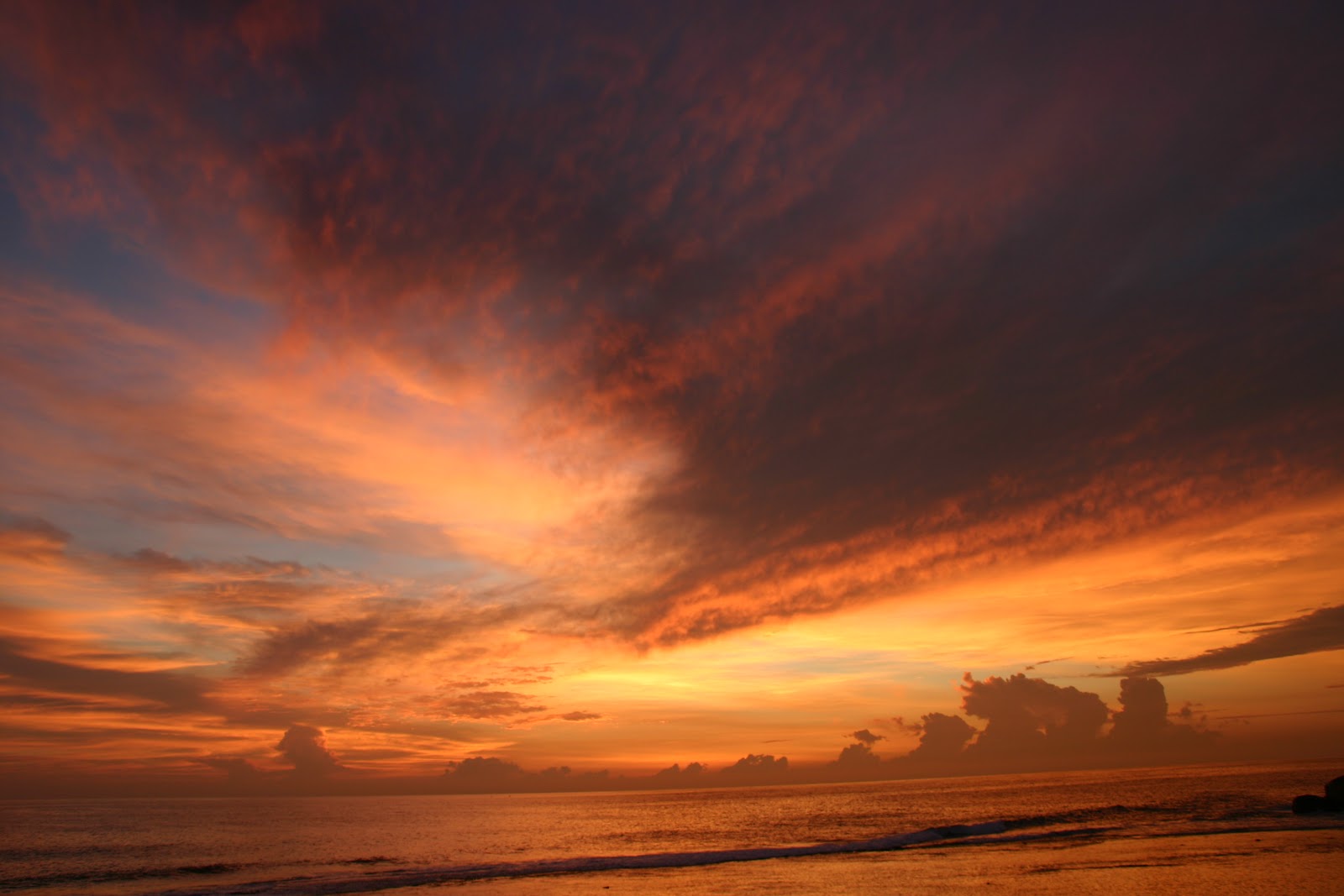
Sunset from Galle fort


Easter Sunday
April 8th.  Yesterday and today we have been out walking in the middle of Dorset.  Yesterday up around Turnworth and part of Bulbarrow Hill with views over to the Northwest to the Blackmore Vale, and today near Cheselbourne, some way West of that with views across to the East to Bulbarrow, Northwards up around Nettlecombe Tout and down over enormous fields of rape back to the car.  Looking to the Southwest we can see the distant tower of the Hardy monument.  Although the trees are not really in leaf yet there is still some beauty in the woods and the skies – wood anemones and bluebells, pure white hawthorn blossom in the hedges, skylarks and buzzards, the drumming of woodpeckers.  The striking thing about Dorset away from the coast is that one sees almost nobody.  We are very lucky to live in this county.  A quiet evening with the final round of the Masters golf to watch.

Hawthorn blossom and a field of rape, Dorset, Easter Sunday