I had firm intentions of just writing about Sri Lanka, with the odd topic of UK home grown news, but so much has been happening in England that I just hope I can reach Sri Lanka by the end of this blog...
I had firstly meant to lament the lack of dedication to work which benefits other people. When a syndicate of bus drivers in Corby won the lottery recently, to a man they just failed to turn up to work the next day. It turns out that this group comprises 20% of all public service drivers in Corby, so the effect on bus routes for the poor workers of this former steel town was substantial. What a load of mean spirited w..... these men are.
At the risk of being a grumpy old man I might as well get it all off my chest. The quality of working life within the NHS continues to go down by several degrees a month it seems. The latest Big Brother episode is the reduction in hours being paid to consultants. While simultaneously being required to do more and more – especially as regards admin and bureaucracy – the number of sessions devoted to non-clinical care, i.e. catching up with medical correspondence, teaching activity, phoning GPs, is being reduced. At least you are still expected to do it, but you won’t get paid for it. Some time back we were warned that use of the internet was to be monitored – and clearly there are sites that are inappropriate – but now if any site is deemed unsuitable, access is blocked. The other day, in my lunch hour (an oxymoron – most people take only a few minutes for lunch and many just eat some sandwiches in their office while answering e mails or dealing with other admin), I went from our home page (no choice, the merry Poole hospital website comes up first) to the main BBC news page (approved), but when I saw the headline ‘England take late wickets to stage comeback in Sril Lanka’ and followed the link – Bingo – Poole Hospital Big Brother threw me out of Internet Explorer, and when I tried the same thing today my computer froze as well!
Many years ago, consultants were encouraged to meet together at lunchtime, and this meant that not only did we know who our colleagues actually were (nowadays we have no idea), but we did sometimes talk about shared aspects of medical care, a subtle but invaluable education for us all. These days it’s regarded as elitist to allow consultants separate dining facilities, so we are all in the same canteen. The only people who regularly dine together and discuss matters both personal and clinical are the pathologists, but even they are being squeezed by big brother managers who maintain that they are taking far too long over lunch. In our brave new pathological world, post mortem examinations have been farmed out to some post mortem factory in Bournemouth, which is not on the site of either of our major hospitals, so it is impossible to attend an examination of a patient who has been under your care to assess whether you have done what was appropriate. Many patients die without any exact cause of death being determined! The reduction in NHS funding has resulted in pressure being brought to bear to reduce referrals to the coroner if one is uncertain of the cause of death. Death certificates are probably as unreliable now as at any time in the past thirty years. Bear in mind that the only thing the Coroner is interested in, when reduced to its simplest principle is: ‘Was death due to natural causes?’ As students at University College Hospital (UCH), many years ago, we were encouraged to attend post mortem demonstrations which took place several times a week if there were interesting cases. As we made our way up the iron stairs to the students’ entrance to the mortuary viewing gallery, an imposing sign lettered in gold on a varnished wood background greeted us, ‘Mors ipsa docet succurrere vitae’, or for those of you whose Latin is a bit rusty, ‘Death itself teaches us to sustain life’. Great stuff.
In politics, we have had some bizarre and unintended black comedy recently. The Chancellor, George Osborne, announced his budget the other week. Pensioners have had some tax breaks – some relaxation of tax banding – which the Chancellor has decided to abandon. Naturally dubbed ‘the Granny tax’, it hasn’t been great publicity for the Conservatives. A review of the budget in the papers reminds readers that in the USA there are certain no-go areas for taxation and fiscal interference, known colloquially by analogy with the electric subway services as ‘The Third Rail’ – touch it and you die! Another somewhat bizarre tax is the imposition of VAT (similar to state sales taxes in the US) on food which is heated before sale. Food is zero rated, but if a pastie is sold at more than one degree above ambient temperature the tax will be imposed. Mr Cameron (our prime minister) recalled that he had recently eaten a very good pastie, but on further investigation it appeared that the business he claimed to have bought it from closed down five years ago. It has always seemed to me bizarre and unfair that when you visit a fast food and beverage shop, e.g. Pret à manger, you are asked if you are eating in or taking away, and if you reply that you are going to eat in, a whacking 20% is added to the bill because it is taxable. Most people say, ‘Oh, take away’, don’t pay the tax, and then sneak off to the far corners of the store and eat in anyway. Sadly, now that the UK is in thrall to the European Union, we have little choice about our taxation system which is dictated by Brussels.
Finally, a remarkable event occurred in politics this week. A By-election in Bradford (West) constituency was won by an independent candidate, George Galloway. Galloway, who calls himself the ‘Respect’ party, overturned an enormous Labour majority and got himself elected. At the risk of boring you, I will not dwell on Galloway’s past history, a very crafty speaker and self-promoting figure in politics who has previously been a Labour MP. He was famously a supporter of Saddam Hussain in Iraq, and has had dubious involvement in certain charities relating to Arabic people. He has coined the phrase ‘Bradford Spring’ to describe his apotheosis. He points out that so many people are disaffected, and suspicious of politics, they are searching for someone who will speak for them, and he is the man. In the newspapers today (4.4.2012) the news is announced of his fourth marriage, to a woman aged 27, 30 years his junior, only 4 months after wife number three gave birth to his second child by her... There is justified speculation about what it can be that attracts them to him. Apart from wife number 1 the others all either look Arabic or have Arabic names.
As a political footnote, as you will know, we currently have an uneasy coalition government, with the Liberal Democrats being the power brokers together with the Conservatives. The Lib Dem leader, a man on a hiding to nothing, is dignified with the title ‘Deputy Prime Minister’. He is one Nick Clegg. A letter in the Telegraph recently came from someone who visited his old prep school, and looked at the honour boards. It was noted that even in prep school, Nicholas Clegg was not the head boy on his own – but jointly. Poor Clegg, no change for him then.
There is no easy segue into tales of Sri Lanka, except perhaps that as I write this, England are playing in their second test match against Sri Lanka, this time in Colombo. Last week it was in Galle, and we would definitely have been there except that hotels in the area would only accept bookings for 5 days rather than two or three during the match. At the time we booked our holiday it was still uncertain that the match would be played in Galle because the Australians had been critical of the pitch during their visit there last year.
The highlight in both literal and metaphorical terms of our visit to Sri Lanka was the High Country, and specifically our ascent of Adam’s Peak, known to Sri Lankans as Sri Pada.
This 2243m high pinnacle is perhaps most sacred to Buddhists, the indentation in the rock at the top being said to be where Buddha placed his foot. But Christians claim it as the footprint of Adam, and Hindus as the footprint of Siva. There are conflicting claims for St Thomas and the Queen of Ethiopia. It was also known to Marco Polo, though he did not visit it. He was aware that fixed chains had been attached to the rock and were needed to ascend it. These days, the entire path up the peak is made up of steps. The first section is a gentle ascent through the gardens which rise up from the ramshackle hamlet of Dalhousie. There is very little to see as one ascends because the majority of foreign tourists do the climb at night, so the tea plantations on the lower slopes are scarcely noticed and the only sights are the booths of the vendors, lit by oil lamps or fires, or occasionally by electric light. The total distance of the uphill climb is about 7Km, though the distance is as nothing compared with the ascent. It’s not too clear how high Dalhousie is – perhaps 800 to 100m. Thus the total ascent is something up to 1500m of altitude. The major problem with the steps however is the fact that the pitch of them varies enormously, from as little as two inches to around 15 inches in some cases. Walking up steps which are a foot high is not easy. The final 30 to 45 minutes is up steps so steep that there is a metal hand rail placed in the middle, which is essential to use.
Every 20 metres or so there is a fluorescent light illuminating the steps. Very occasionally the light is not working so one needs to step carefully until the illumination improves. All the way up there are booths, the occasional beggar, religious pedlars, and resting places where the religious adherents can stop and lie down. Many of them spend hours here overnight sleeping, and can take up to a day to make the ascent. We have no idea how long it is going to take us to climb – the guide book estimates 2½ to 3½ hours.
Our guide and chauffeur from Red Dot tours, Ervine, has said that we might take an hour to reach Dalhousie from the Tea Trails Norwood bungalow, and dawn is predicted at around 0630. The alarm goes off at 0145 hours and we are in the car and on our way just before 2am. On the road we see a few denizens of the night – a ring tailed civet runs across our path; a porcupine rattles its way into the brush; a pair of wild boar trot briefly alongside before abruptly turning off. In the dirt car park at the entrance to Dalhousie there are literally hundreds of cars and coaches – all empty. Where are their occupants? On the hill somewhere presumably.
As we start, there are a few back packers, but once onto the steps it’s clear that most of the pilgrims are local people, of all levels of ability. Young husbands cradling babies, grannies with walking sticks, obese mothers. Some of them are still asleep in the resting areas, huddled shapes swathed in blankets like the famous pictures of the figures on the underground platforms during the blitz in WWII. We have started walking at about ten to three in the morning. It’s cool and vendors huddle over open braziers, glancing at us as if they realize that hopes of selling supplies or religious emblems are small. There is little to report except that we just walk and walk and climb and climb. We are using our walking poles which are very helpful to reduce the legwork, and will prove even more useful on the way down. I have rather a heavy backpack with two cameras, binoculars, water, a waterproof, and a fleece. A German girl with no backpack, who possibly weighs about 50Kg as opposed to my 85Kg, and is wearing leggings that appear to be sprayed on to her lovely legs and gorgeous backside pauses to ask me something. Sadly all she wants to know is the time. Having got the answer, she skips lightly up the next flight as if she were walking on air. Other more seriously clad tourists march on past us, but as we find out later, it is a case of the tortoise and the hare, and we make the top very much at the same time as most of these younger walkers, some of whom are about 40 years younger than I am. Apart from the Sri Lankan families, there really are only three people who are about our age on the walk. Two of them are a German couple who do not manage to make it. One is a somewhat hippyish grey pony-tailed man, who is very slim and fit looking for his age. He has no trouble. If you are not comfortably able to do a major hill walk of about 10 miles then I would advise not tackling Adam’s Peak. Surprisingly we meet as many people coming down – all local pilgrims – as we see going up. Clearly they have not been bothered to stay to see the dawn. I ask a slightly plump lady in a sari what time she started the climb. ‘About 6pm’ she answers. It’s now about 4.30am, so her journey has taken ten and a half hours so far.
Once one is clear of the gardens and firmly engaged on the climb, we can at times see the lights marking the route winding up to what we assume is the top. It doesn’t seem too far. But this is misleading. What we can see is probably only the next section before the path winds out of view. After about an hour or so I suggest to Lindsay that we should take it easy. We don’t want to be at the top and hang around in the cold for an hour or more. This appearance must be deceptive – the steps just go on and on, and we can’t really spot where the summit is. I have decided that we should do this army fashion. We will walk at the pace that we will maintain for the whole ascent. Every 55 minutes we will stop for around 5 minutes, and then resume. But now we’ve been going for two hours and it seems that we are nowhere near the top. After about two hours and twenty minutes I ask one of the booth holders how much further it is. At least another half an hour he says. And it is. It takes us in all two hours and fifty-five minutes to reach the top. The last twenty to thirty minutes is the section where the steps are so steep that we abandon the poles and use the rails to help pull ourselves up. Amazingly, as we arrive at the level segment by the temple, we see that there are hundreds of people already arrived. It’s cool, and you need a fleece, but it’s not too bad. Perhaps that is because of the cloud cover, it is not a clear night. There is a faint lightening of the sky in the east through the clouds. Some rain or mist bearing clouds drift across us and everything is suddenly wet, even though it doesn’t feel as though it has rained. An angry red flush appears in the sky, and the clouds and the lake below become visible in shades of grey. After the red horizon, the sun is obviously on its way, but the clouds conceal it, so after about 30 minutes on the top we decide that it isn’t going to become any more attractive so we start down again. At the start there is a huge throng, mostly making their way slowly down the most severe of the steps. Eventually we can pass them, and the pace of our descent improves. I’m surprised that our journey downwards takes around two hours, but two hours it is. It’s nice to see that landmarks become visible as time passes by, so that we can see where we have been. The bazaars and booths appear even more tawdry in the grey light of dawn. The garishness of the kitsch religious items is jarring for westerners. Finally we find Ervine. We jolt back along the rough roads past Maskeliya to Norwood bungalows where we arrive at about 0915, in time for a spectacular breakfast on the terrace. The only activity that I can compare Adam’s Peak with is our ascent of Cathedral Peak in the Drakensberg, which was even tougher – longer distance, and ascent from 1400m to 3000m. The fact that Adam’s Peak is all steps means that our muscles are challenged in such a way that it is very difficult for us to walk or to climb up or down stairs for about five days afterwards. Here are some pictures to illustrate the climb:

Adam's Peak from Maskeliya Lake

Pilgrims on the peak waiting for the dawn

First light from Adam's Peak

Descending from the Peak

The start of the steps proper up to Adam's Peak
I would like to add so much more about Sri Lanka, but it would almost certainly bore you. The spectacular nature of the World Heritage sites at Dambulla and Sigiruya, the picture perfect nature of the high tea country, walking up trails between the tea bushes and through woods of cardamom groves, the heat and sunshine on the south coast and the tranquil charm of the old town of Galle inside its ancient fortifications. Enough.

A view across the roofs of Galle town
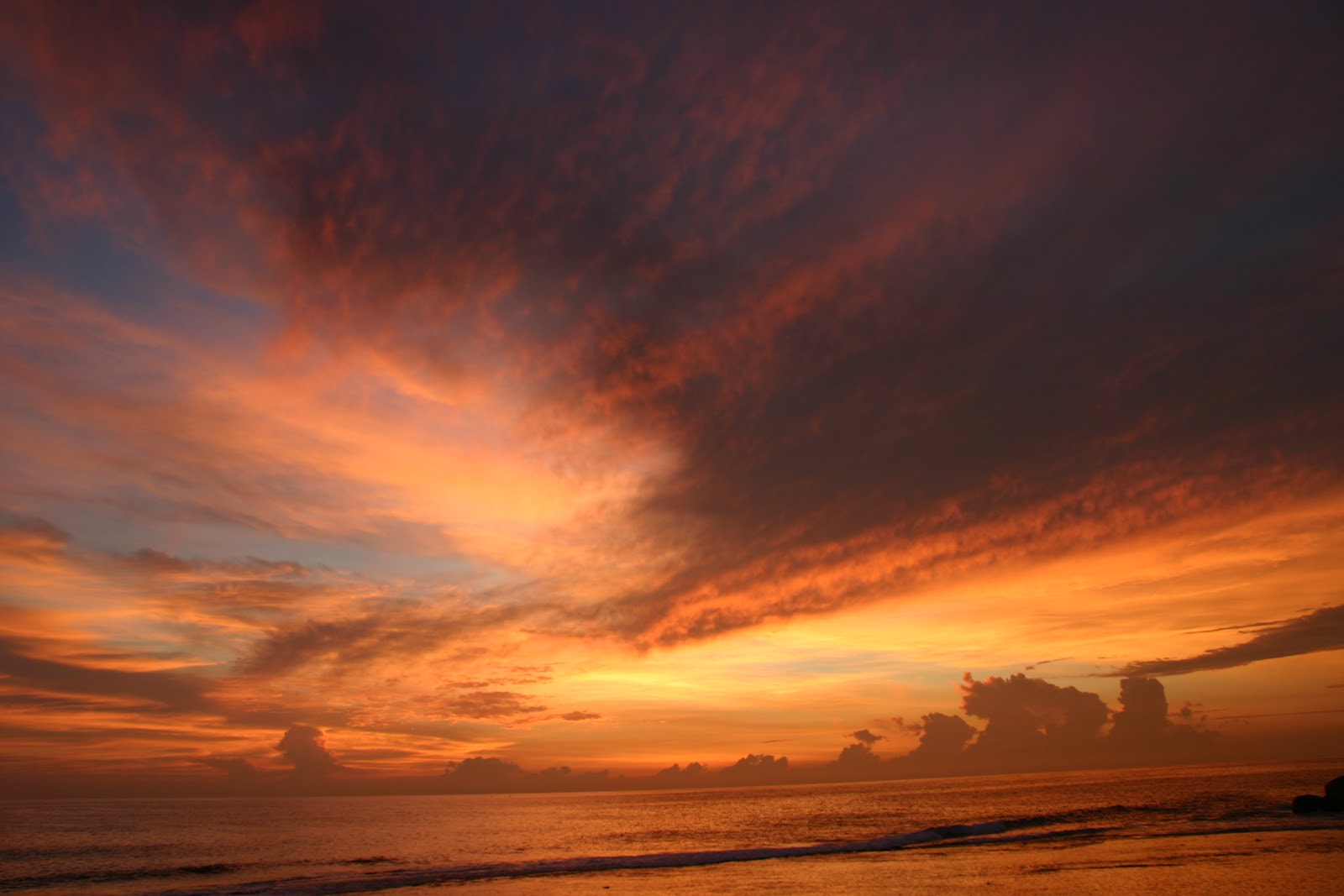
Sunset from Galle fort
Easter Sunday
April 8th. Yesterday and today we have been out walking in the middle of Dorset. Yesterday up around Turnworth and part of Bulbarrow Hill with views over to the Northwest to the Blackmore Vale, and today near Cheselbourne, some way West of that with views across to the East to Bulbarrow, Northwards up around Nettlecombe Tout and down over enormous fields of rape back to the car. Looking to the Southwest we can see the distant tower of the Hardy monument. Although the trees are not really in leaf yet there is still some beauty in the woods and the skies – wood anemones and bluebells, pure white hawthorn blossom in the hedges, skylarks and buzzards, the drumming of woodpeckers. The striking thing about Dorset away from the coast is that one sees almost nobody. We are very lucky to live in this county. A quiet evening with the final round of the Masters golf to watch.

Hawthorn blossom and a field of rape, Dorset, Easter Sunday
