TUESDAY FEBRUARY 8th, 2022
Time to record the first swim since New Year’s Day. Freezing – well, it was 8 degrees C. Just for the record, you understand. Nothing else to add.
MONDAY FEBRUARY 14th, ST VALENTINE’S DAY
 |
| Valentine cupcakes, courtesy 'Maggie the Seaside Baker', q.v. |
 |
| Advice and a 'handshake' from Maggie the Seaside Baker |
 |
| Bingo! |
 |
| Google knows where you are and what you are doing. Evidence that I did isolate for the period when I was Covid positive. |
There were two images that came to mind. The first being the Edgar Allan Poe short
story, ‘The Masque of the Red Death’, where Prince Prospero, his Kingdom
devastated by the pandemic of the Red Death (evidently a sort of haemorrhagic
fever, such as we know as Lassa or Ebola), takes 1000 of his healthy high born
courtiers and subjects into his Royal Apartments and bids his armourers seal
and weld all doors. Of course (spoiler
alert), the Red Death gets in. Perhaps,
for Prince Prospero, one should substitute the name Jacinta Ardern, Prime
Minister of New Zealand?
The second, more subtle illustration, is from Dylan Thomas. ‘In Country Sleep’ is one of his later
poems. In the poem, written in Italy,
and generally thought to be addressed to his daughter Aeronwy, ‘the Thief in
the night’ threatens to get in, no matter what precaution one takes. In the first stanza, the Thief is described
in nursery rhyme terms as the ‘wolf in a sheepwhite hood’, but later, more
specifically, ‘Be you sure the Thief will seek a way, sly and sure’. And, ‘Ever and ever, he finds a way, as the
snow falls, As the rain falls, hail on the fleece…’ These lines sound a little prosaic, taken out
of context, and without that wonderful voice reciting them. Do listen to Dylan reading it.
Who is the Thief?
Multiple critics have attempted to answer this, with surprisingly
different results. Who am I to better
their attempts!? Thomas himself gave
several interpretations, sometimes depending on whether he was feeling paranoid
about Caitlin’s possible dalliances, or whether he was drunk. Paul Ferris, in his biography of Thomas
(p212) rehearses some of these. But generally,
the Thief is assumed to be Time or Death.
We know that Thomas took his compositions very seriously, at least at
this stage of his life. The working
sheets for a poem written at a similar time, ‘Over Sir John’s Hill’, are
complete, are preserved in Harvard College Library, and run to 47 sheets of
paper, and this poem is less than two-thirds the length of ‘In Country Sleep’.
So, at last, the Thief of Covid-19 has found a way, and it
doesn’t profit to imagine whether my illness would be different if I hadn’t had
a total of four vaccinations. It was
unpleasant enough…
So much for the self-indulgence of talking about oneself. As for Dylan Thomas, and attempts to analyse
him, best to leave the last word to Cyril Connolly: ‘At his best he is unique,
for he distils an exquisite mysterious moving quality which defies analysis as
supreme lyrical poetry always has and – let us hope – always will.’
The reader will realise that I have had, for many years, a
huge affection for the poetry of Dylan Thomas.
It’s interesting that his contemporaries were also attracted to him,
despite his many faults. He borrowed and
never paid back; he stole; he was frequently drunk and incapable; he was
faithless; he told lies. His first poem,
at least the first poem for which he was paid, he sold to The Western Mail, and
is entitled ‘His Requiem’. Many years
later, in 1971, someone found the poem, written by a Miss Lilian Gard, in a
‘Boy’s Own Paper’ of 1923. Perhaps it is
because I first heard of him, when at the age of ten, I was condemned to, or
granted the benison depending on your point of view, of living in Fishguard, in
rural West Wales from 1958 to 1961.
Richard Burton promoted Fishguard as the inspiration for ‘Under Milk
Wood’, and directed his film version of the play there. The film crew took over the last little
cottage on Lower Town quay and converted it into Blind Captain Cat’s cottage
(where Peter O’Toole sat). The townsfolk
complained of the disruption, but at least the Ship Inn did well out of the
heavy drinking actors. A note signed by
Burton and others states that on a certain date (1970 or 1971?) the cast and
crew drank the pub dry. Burton was also
kind enough to write in the visitor’s book at Fishguard Bay Yacht Club that it
compared favourably with the Royal Thames Yacht Club. As regards the location of Llareggub, it
seems more likely that New Quay, north of Cardigan was the inspiration, though
the many churches and chapels of Fishguard, and his origins in Swansea are also
possible amalgams of the town. But in
1958, few in Fishguard, five years after Thomas’s death, had a good word to say
for him. Now regarded as one of Wales’s
finest poets; at that time he was regarded as something of an
embarrassment. Naively (aged 11) I asked
a dinghy sailor at Fishguard Bay Yacht Club, why his super-fast fibreglass
dinghy, with which he won all the races, was called ‘Polly Garter’. ‘Because she’s no better than she ought to
be’, he replied. My mother refused to
explain this. It stimulated an obvious
attraction for the creator of Polly Garter.
I return to an issue that remains the elephant in the Covid
room – ever since the location of its origin emerged, or even since Donald
Trump referred to ‘The Chinese Virus’, a possible clue as to the correctness of
the laboratory-created virus theory has always been that the nearest animal
relation of the virus carries a genome similarity of only around 95%, whereas
other viruses passaged through and identified in animal species tend to have a
much closer homogeneity to the virus responsible for epidemics or
pandemics. So to create the SARS-CoV-2
virus implies a substantial, and possibly engineered difference in the
nucleotides coding particularly for the spike protein.
The most recent piece of the jigsaw comes from an unlikely
source, as reported by the Daily Telegraph (Sarah Knapton).
The University in Budapest had soil samples taken in
Antarctica in 2018 and 2019. In December
2019, these were sent to Shanghai (Shangon Biotech) for genetic analysis. The samples were subsequently found to be
contaminated with a previously unknown variant of SARS-CoV-2. This variant has a genome which shares
features with both the nearest previously known bat coronavirus and the
earliest Wuhan strain. Other findings in
the samples contain hamster and monkey DNA traces, perhaps pointing to growth
of the virus in animal cell lines, such as would be undertaken in a
laboratory. Sangon Biotech is often used
by Chinese researchers for sequencing.
If the work was undertaken before the end of December 2019, this
finding would be evidence for a laboratory leak. If afterwards, it might just be contamination,
as scientists in Wuhan struggled to identify the virus.
Monday February 21st, 2022
This is the first day that I have felt substantially better,
and the lateral flow test is pristinely negative. A little stroll round Whitley Bay and
back. Still very windy. We have had three named storms in the last
four days – Dudley, Eunice, and Franklin.
Most of these major depressions move further northwards than Poole, but
Eunice was unusual in having its highest wind strengths on the south
coast. 122mph gusts were recorded at the
Needles, Isle of Wight. Some major
branches down from trees and a lot of debris, but otherwise the new house stood
up to it.
 |
| Fun in high winds in Poole Harbour |
My illness, from which I am still fatigued, has at least
allowed me to read the new biography of George III, by Andrew Roberts, a recent
birthday present. Weighing in at over
750 pages including the notes and bibliography, it is a welcome re-evaluation
of George III and his role in 18th and early 19th century
politics. During almost all of his
reign, Britain was at war with somebody, whether France, Spain, the American
Colonies, or other sundry nations such as Denmark. Mindful of what had happened to Charles I, George
was careful not to overstep his Royal prerogative, though this also allowed him
to put blame on his ministers and parliament, who with the exception of the
Pitts, were generally hopeless. The
corruption, and the violence and rioting which characterised the time, were
appalling. (The Police Force was not
established until 1829). George was one
of the few Hanoverians who was guided by moral principles. He was lucky to escape hurt during various
riots, and also survived several assassination attempts.
Perhaps most interesting to me was the reassessment of
George’s illnesses. Soon after I became
a medical student, the papers and book by Dr Ida Macalpine and her son, Dr
Richard Hunter, provided what seemed to be conclusive proof that George suffered
from acute episodes of (variegate) porphyria. I believed this theory, even to the present
day. Alan Bennett’s play, and Nicholas
Hytner’s film promoted this too. But
meticulous re-examination in 2010 by Dr Tim Peters and Dr D Wilkinson strongly
suggests that George suffered from acute hypomania – what we would now call
bipolar disorder. I can’t do better than
quote from the abstract of their vigorous rebuttal of the Macalpine/Hunter
theory:
‘The diagnosis that George III suffered from acute porphyria
has gained widespread acceptance, but re-examination of the evidence suggests
it is unlikely that he had porphyria. The
porphyria diagnosis was advanced by Ida Macalpine and Richard Hunter, whose
clinical symptomatology and historical methodology were flawed. They highlighted selected symptoms, while
ignoring, dismissing or suppressing counter-evidence. Their claims about peripheral neuropathy,
cataracts, vocal hoarseness and abdominal pains are re-evaluated; and it is
also demonstrated that evidence of discoloured urine is exceedingly weak. Macalpine and Hunter believed that mental
illnesses were primarily caused by physical diseases, and their diagnosis of
George III formed part of a wider agenda to promote controversial views about
past, contemporary and future methods in psychiatry.’ (History of Psychiatry, 2010)
The appendix to the present work demolishes the porphyria
theory completely.
Of some interest, in view of my previous comments about
rapacious doctors, is the account of the various famous physicians who controlled
and maltreated the King in 1765, 1788-9, 1801, 1804, 1810-20.
During the King’s last illness, the most famous physician of
his time, and even to this day the longest serving president of the Royal
College of Physicians, Sir Henry Halford (PRCP 1815-1844), together with Sir
William Heberden, Henry Dundas, and Henry Reynolds, were chiefly in charge of
the King’s care. Four major works on the
treatment of insanity were published between 1806 and 1809, yet when questioned
by parliamentary committees, it emerged that these distinguished physicians had
read none of them. Halford in particular
was doctor to four monarchs, including Queen Victoria. A medical historian (Sir Roy Porter) wrote:
‘So suave was his bedside manner, that some aristocratic women were said to
prefer dying with Sir Henry than living with lesser physicians.’
Robert Willis, having some experience of treating the
insane, is treated relatively kindly by Alan Bennett in his play. Yet a ditty of the day went:
The King receives
three doctors daily –
Willis, Heberden and
Baillie:
Three distinguished
clever men,
Baillie, Willis,
Heberden;
Doubtful which more
sure to kill is,
Baillie, Heberden or
Willis.
(Quoted by Roberts from a British Medical Journal of 1914)
Finally, it should be noted that the doctors continued to
charge huge fees. By the time the King
died (January 1820), the amount spent on them since January 1812 totalled
£271,691 and 18 shillings (almost £34 million in today’s money).
The last time I was ill for so long a period was a genuine
episode of influenza, which prostrated me some thirty years ago. It allowed me to read ‘The Lord of the Rings’
in an uninterrupted sequence. I had been
looking forward to it, having read The Hobbit many years prior. In the event, although the story started well
enough, I found it tedious, and nothing like as enjoyable as The Hobbit (could
it be that reading the one in one’s teens and the other in one’s 40s had
something to do with it?). It was during
my time in Cambridge, in the late 1960s, that TLOTR became a cult. There was a club which called itself ‘The
Hobbits’ and to get into it one had to be interviewed and answer correctly
searching questions at random from the books.
Life seemed too short, especially when studying Medicine, and Groucho
Marx’s remarks about clubs come to mind.
I do remember a very successful discotheque during my time there called
‘The Desolation of Smaug’. Well, anybody
who can read TLOTR which contains a geographical feature, key to the story, called
‘The Crack of Doom’ without breaking into ribald laughter ranks in the same
category as Charles Dickens’ readers, of whom Oscar Wilde wrote, ‘One must have
a heart of stone to read the death of Little Nell without laughing.’ I have sympathy with the Oxford don
(Professor of English, Hugo Dyson) who, in the Merton SCR, listening to Tolkien
declaiming his latest passage from TLOTL, said, ‘Oh no; not another fucking elf,
Ronald?’
Thursday February 24th
The above seems rather trivial, compared to the news
today. I have not felt so uneasy since
Nine-Eleven. Vladimir Putin, or rather
Russian forces at his command, has invaded Ukraine with simultaneous attacks
using helicopters, aircraft, and missiles, aiming to neutralise any Ukrainian
armed response. Images show Russian
military vehicles crossing borders without any attempt to stop them. After 22 years in power, as one correspondent
stated this evening, with effectively no opposition, Putin considers himself
invincible and it appears he has a Messianic mission to avenge Russia’s
humiliation of the 1989 fall of the Soviet bloc. As mentioned before, Ukraine is a NATO
partner, and not a NATO member, so there is no armed response from the
West. But it seems likely that Putin may
target Poland or the Baltic states next, and they are among the 30 members of
NATO. The response from the UN is
predictable – a rather pathetic ‘Please Stop’.
Sanctions are being announced, with the USA response expected later tonight. These will not have any short term effect
however.
So, relegated to the second division are discussions about
Partygate, and even Covid has taken a back seat. Prince Andrew can relax for the first time
for months.
The charming Laura Kuenssberg has tweeted that now Tories
are worried about mass immigration from Ukraine… later in the day however she
seems to be covering the story in a more considered manner, though she has
jumped on the news that many MPs including Tories do not think the sanctions against
Russia go far enough. In my own cynical
way I wonder whether Putin has delayed striking against Ukraine until now to
allow his Russian athletes, masquerading as ‘Russian Olympic Committee’ to win
all their medals at the Winter Olympics.
(Note added 3.3.2022: there is a credible intelligence source suggesting
that President Xi had been in touch with Putin over exactly that scenario).
Feel a bit rough again post Covid, with a sore throat. Time for bed.
Thursday March 3rd, 2022
It has been a week of unremitting horror in Ukraine. At times in the past I have counted my
blessings, relieved to have lived such a long life untainted or unthreatened by
war. I have idly wondered how my parents
felt – my father at just 21, my mother at 19, when the Second World War was
declared; their lives altered irrevocably by one madman. And now here we go again. This is the iPhone war, the TV war, and awful
images are now commonplace. During my
life we have had single, powerful, and frozen in time images to tell us that
war was taking place – the little girl running naked down the road in Vietnam
after a napalm strike; Syria, Afghanistan, the Falklands, and many others. These seem to recede into the distance
compared to what is now going on in Ukraine.
Already, one week in, one million people have fled the country. Males aged 18 to 60 are not allowed to leave
– their families joining the 40 kilometre queue at the Polish border. Putin speaks bizarrely of ridding the country
of Nazis. Many feel that his personality
has changed; some question his appearance as evidence of some inner
pathology. A Matt cartoon last week in
the Daily Telegraph shows a sign outside the city of Salisbury – ‘We warned you
about him’.
At the Bournemouth Symphony Orchestra concert last night,
the CEO read a message from our Ukrainian chief conductor, Kirill Karabits,
thanking us for our concern for his country.
The lights changed to blue and yellow.
Kirill is in France at the moment, but is due to conduct here in Poole
in two weeks’ time.
 |
| My wonderful original 1960s purchase of the DG 12" LP of Sibelius violin concerto. Worryingly, Finland is not a member of NATO |
As I write this evening, it seems that Putin’s tactics have
changed to an altogether more barbaric strategy. His forces bogged down on the ground, he has
resorted to pulling back and just raining destruction on Ukrainian cities –
indiscriminately targeting residential areas.
Russian involvement in Ukraine before, and in Syria has focussed on
completely levelling the cities. Safe,
many miles away, his commanders can merely press the button and send cruise
missiles or other ordnance in to destroy.
It seems possible that President Zelensky will call for surrender rather
than allow so many more defenceless Ukrainians to suffer.
Meanwhile, in the United States, many, many miles away,
President Biden gave his State of the Union address. He was applauded for promising to help
Ukraine, but to many critics he appeared fuzzy, and did not help himself by
saying ‘Putin… will never gain the hearts and souls of the Iranian
people.’ Conservative commentator, Ann
Coulter, observed ‘That’s a relief!’
More than half of Americans polled by ABC News/Washington Post do not
believe that Biden has the ‘mental sharpness it takes to serve effectively as
President.’
It seems to me that Ukraine’s invasion is entirely analogous
to Hitler’s invasion of the Sudetenland, part of sovereign Czechoslovakia, on
the pretext that many native Germans lived there, and that it should be
Germanized again. At that time, our line
in the sand was Poland, and only when Hitler invaded Poland did we declare
war. This time it is the Baltic States
and other members of NATO (or OTAN) in Europe.
I had so many other things to write about – the detection of
the antianginal drug trimetazidine in a urine sample of a 15 year old Russian
ice skater; a remarkable observation about cricket; more about Dylan Thomas –
but these will have to wait.
Parenthetically, it seems reasonable however to mention
Covid. A paper in the New England
Journal of Medicine, today, March 3rd, is a review of the efficacy
of vaccinations against the Omicron variant – and it is nowhere near the
effectiveness displayed earlier to the first coronaviruses. There is some protection, but with various
combinations of primary and booster doses, it’s difficult to tease out which is
best. Protection is at best around 60%,
and has been shown to wane with time. It
seems to bear out my experience. I still
have paroxysms of coughing, and sleep late most mornings. (Added note: further NEJM papers bear this
out in other countries – omicron is less well protected against, but
nonetheless there does appear to be protection against serious illness and
death).
Yet again, the Wuhan story has been re-examined and some
scientists have suggested that the origin was indeed the Wuhan wet market. The paper has not been peer-reviewed and will
obviously bear further assessment.
Sunday March 6th
More articles questioning how on earth we were so gullible
as to allow London to become ‘Londongrad’ for so many corrupt Russian
businessmen. Party donations, visas for
sale, a process it seems dating back to John Major, but just in case any left
wing readers feel reassured, substantially endorsed by Tony Blair and his successors.
Cold, bleak winter sunshine.
Strong north-easterly winds.
This next paragraph may jarringly intrude, but for many, the
death of Shane Warne, cricketer, greatest leg spinner of all time, from a
suspected heart attack at the age of 52 has come as a massive shock. Rodney Marsh, greatest Australian gloveman,
has also died from a heart attack. Warne
lived life to the full, but his diet of junk food and cigarettes obviously
caught up with him. As another evidence
of the naivety of successive generations about history, a friend recently told
me that his grandson asked him, ‘Dad, what franchise did Donald Bradman play
for?’ I am not going to go into the
details of that for American or Canadian readers, only because it would take
too long. They may guess from his dates
of birth and death – 1908 to 2001. Note
to American readers – cricket is our baseball, though there may be a social class
difference.
I feel very sorry for all the Paralympic athletes. Apart from the occasional minor news item
that tells us somebody from GB has gained a medal, the interest in the Winter
Paralympics must be almost zero. The BBC
does not cover it – it appears on Channel 4 in the middle of the night.
Covid is no longer the main topic of conversation. Whitty and Valance, so important in the early
pages of this diary, are nowhere to be seen.
Instead, current and recent figures from the Armed Forces deliver our
briefings these days.
This diary will now become the ‘War Diary’, not the Corona
Diary. Will it ever see the light of
day?
Thursday March 10th
The war has continued for two weeks. The obscenities of it are almost
unspeakable. An image of a small girl in
a pink padded jacket lying dead in the gutter.
Yesterday the airstrike or missile strike of a hospital for mothers and
children. How long can the West tolerate
this? The fear of escalation and the
fact that we have no commitment (officially) to Ukraine stops a
European/NATO/US response. I still think
this is the Sudetenland moment and there will be more to come. It is remarkable how many BBC reporters seem
to be in Ukraine (chiefly in Kyiv, though also elsewhere). The unmistakable New Brunswick tones of Lyse
Doucet who seems to be in every war zone.
We also have the familiar sound of Fergal Keane. A dedicated reporter, and highly respected,
Keane nonetheless possesses the ability to lower one’s spirits just in the tone
of his voice. I am sure if he read P.G.
Wodehouse to us it would sound equally depressing.
A moment of history yesterday – Volodymyr Zelensky,
Ukrainian President, became the first head of state to address parliament in
person, by satellite link.
It is very hard to focus on other matters. I had to look on my phone for some pictures
to remind us that life goes on, so here they are. Some daffodils, the early morning sunlight
shining through; boats on the hard at the Royal Motor Yacht Club, waiting for
Easter and launching. Our Ukrainian flag
flying from our flagpole. Is this just
bourgeois breast beating or a meaningful symbol of solidarity?
 |
| Spring approaching |
 |
| 'Weapons of Happiness', yachts awaiting Spring launching, R.M.Y.C. |
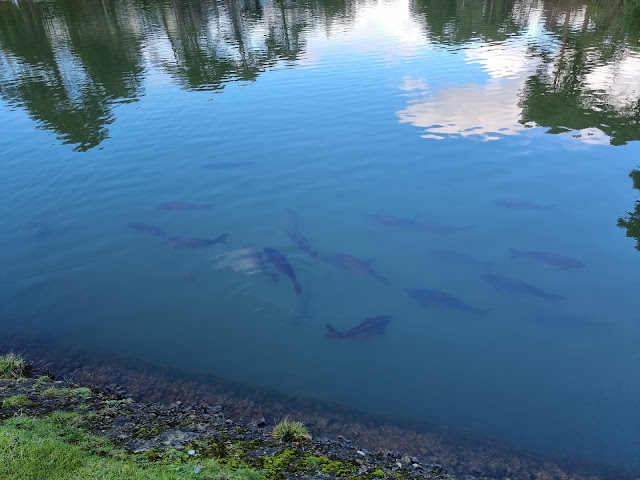 |
| Carp, Luscombe Valley lakes, Parkstone G.C., Poole |
 |
| Our Ukrainian flag - solidarity at least |
Some years ago, inspired by all the boats of various shapes
and sizes that one can see in various drives and in front of houses, I felt
that I should create a montage of the more colourful craft, and enter it into
the Royal Academy Summer Exhibition under the title ‘Weapons of
Happiness’. The title is taken from an
awful play by Howard Brenton which I went to see at the National Theatre many
years ago. Apart from its left wing
sermonizing tedium, and the fact that a motorcycle appeared on stage, I
remember nothing of it apart from the clever title. I believe it comes from the Bible: ‘All the
bright weapons of happiness wait only for a sign’. Apposite to the war perhaps, but in my context
it contains the pregnant happiness that awaits the launching of boats in the
springtime.
Research fails to find the biblical quotation; I only
remember the context from Brenton’s introduction in the programme. If it is not from the Bible, perhaps it could
be Karl Marx? Brenton is or was a
Marxist. Research also indicates that
the cast was stellar – Frank Finlay, Julie Covington, Michael Medwin, Bernard
Gallagher. It was the first new play
commissioned by the National and premiered in July 1976. David Hare was the director; Peter Hall the
artistic director. My view of the play
is shared. Most reviews were
unenthusiastic. It has only been revived
once, in 2008, in a peripheral theatre, and was not well-reviewed.
A propos of 'Google knows where you are', I received this heatmap of my wanderings over the last several years - golf in Ireland, cycling the North Coast 500, cycling the Hebrides, walking the North York Moors, walking in Cornwall. Parenthetically I wonder - does Vladimir Putin have a similar heatmap? And might it be useful?

At this point, unless some other important issue comes
forward, I think it appropriate to cease my Corona diary. I will continue to write a diary/blog. In a more skeletal form it may reappear.
I close by giving you two meaningful entries from
newspapers, in 1853, and 1969 respectively.
Do not read the name of the first correspondent until you have read the
article:
‘…These vital
interests should render Great Britain the earnest and unyielding opponent of
the Russian projects of annexation and aggrandisement…Having come thus far on
the way to universal empire is it probable that this gigantic, swollen power
will pause in its career? With the
Albanian coast … she is in the very centre of the Adriatic … It would appear
that the natural frontier of Russia runs from Danzig or perhaps Stettin to
Trieste. As sure as conquest follows
conquest and annexation follows annexation, so surely would the conquest of
Turkey by Russia be only the prelude to the annexation of Hungary, Prussia,
Galicia and the ultimate realization of the Slavonic Empire. The arrest of the Russian scheme of
annexation is a matter of the highest moment.
In this instance the interests of democracy and of England go hand in
hand.’
From the New York Tribune, 12 April 1853, by its European
correspondent, Karl Marx.
This was written shortly before the start of Crimean War, an
anti-Russian alliance of Great Britain, France, the Ottoman Empire, and
Piedmont-Sardinia which achieved eventual victory, at some cost. The Treaty of Paris (1856) effectively barred
Russian warships from the Black Sea.
Putin seems to have a long memory.
And with regard to military or national leaders, perhaps
Putin should also take note from two entries to The Times, on 3rd
September 1969, in the In Memoriam section.
Depending on the results of his current incursion into Ukraine, will he
be regarded in the former or the latter category?
Oliver Cromwell, 25th April 1599 – 3rd September
1658.
Lord Protector, 1653-1658.
Statesman, General and Ruler.
‘Let God arise, let
His enemies be scattered’.
-Psalm
68, verse 1.
In honoured remembrance.
Cromwell. – To the eternal condemnation of Oliver, Seditionist, Traitor,
Regicide, Racialist, proto-Fascist and blasphemous Bigot. God save England from his like. – Hugo Ball.
I freely confess that I found these entries in my copy of the
Commonplace Book of John Julius Norwich, 1971.
Those who are interested in following someone with a huge
amount of experience, an ex-Diplomat, non-partisan commentator (though you
might not think it from her contempt for the current government), should take a
look at the writings and Tweets of a distant ‘friend of the family’, Alexandra Hall
Hall. Her hashtag is:
@alexhallhall. What
she says is usually worth reading… She
has far more international experience and far more intelligence than virtually
any inhabitant of the ‘Mother of Parliaments’.
Even that title is a misnomer, if you visit Iceland and go to
Thingvellir, the true Mother of Parliaments.
Good bye.
Andrew McLeod


